
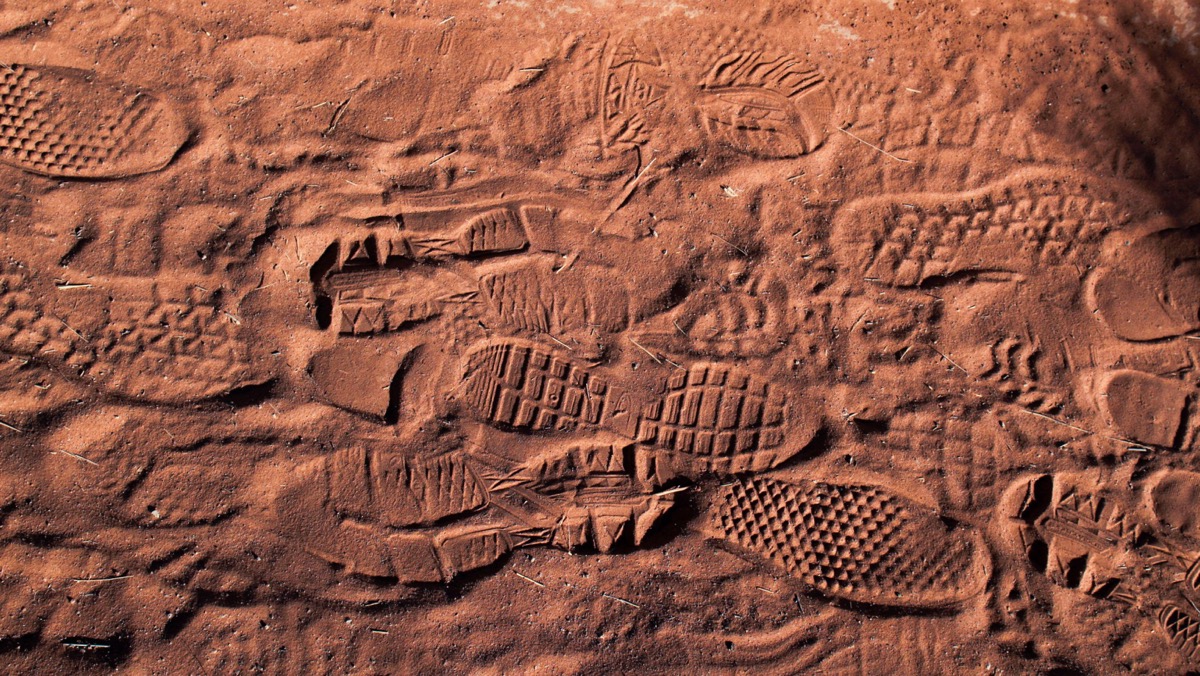
Photo by Jacob Campbell
The Helmet Game
by Neil James Hudson
If Earth people had to breathe Martian air, I think they’d make more effort to look after their own. For one thing there isn’t much of it. You’d have trouble getting it into your lungs in the first place. And once there, it wouldn’t do any good. There’s plenty of oxygen, but it’s all bound with carbon, which isn’t going to let it go to keep humans alive. You could last a few minutes, and few more if you had time to prepare, but you’ll suffocate soon enough.
“Would you like to see the body, Ms. Connors?” asked Commander Walberg.
“Amanda,” I said. I was one of the few people here without an academic or military title. Only the students matched me in this. I felt as if my name were paraded naked as a mark of shame. “And I know what a dead body looks like.”
Max Weill suffocated two metres away from his helmet. His gloved hand was outstretched, as if he were trying to pull the ground towards him. He asphyxiated before he froze.
“His footprints were found between the helmet and his body,” Walberg said. “As far as we can tell, he took it off himself, then walked away from it.”
I nodded, unable to think. I knew exactly what had happened and didn’t want to get caught up in it again. “Were they the only footprints?”
He led me through a door through the medical wing, and I realised he intended to show me the body anyway. I said nothing, not wanting to appear squeamish. If this was a chance to redeem myself, I needed to take it. The unit contained half a dozen beds; it was a very strict rule that no more than six people were allowed to be ill at a time, a rule that had so far been obeyed to the letter.
At the back of the unit was the rarely used morgue. It was rarely cleaned as well, I thought, concentrating on the dust that coated the shelves and desk rather than on the inert body that lay on the wheeled table in the middle. Without his suit he seemed too fragile for this planet. His frame was small, and he seemed surprisingly low on muscle. Weight training was compulsory and most of us carried fairly powerful bodies. I guessed he had not been here for long. I forced myself to look at his face. I expected to see an expression twisted in agony, perhaps despair that his salvation was only a body length away, further than he could reach. Instead, he seemed to be at peace. His eyes were closed and his mouth set in the smallest of smiles. This calmed me down a little, and I was considering repeating my question when the Commander spoke again.
“His footprints showed that he had not walked the two metres from his helmet. He had walked a hundred and forty-five metres, then returned. He seems to have removed his helmet before setting off; unless he removed it at his final resting place and threw it, but there’s no sign of a landing or a skid in the dust. I’m told you have some experience of this.”
A picture flashed in front of my mind, one that I usually saw only in dreams. A face, its flesh contorted in the way I had expected to see in Max Weill’s. Someone who had wanted to get back.
“It’s called the Helmet Game,” I said. I wondered how much he knew about me. I guessed that he already knew everything I was about to tell him, and he was just sounding me out. “It’s a dare game. You take your helmet off, set it on the ground, and walk as far away as you can while still being able to get back before you pass out from lack of oxygen. Too short, and it’s not a challenge. Too far, and you lose the game.”
“One hundred and forty-five metres?”
I found that my breathing was quickening already. I tried to slow it. “You start by hyperventilating. Breathing in and out as fast as you possibly can. It flushes the lungs with oxygen and allows you to hold your breath for much longer than you normally could. It’s dangerous in itself but, there are records of Earth pearl divers staying under for fifteen minutes.” I gave up. “Can we leave?”
He nodded—to himself I thought—having won the small contest he’d set. But he showed me to the door and escorted me through the ward without belittling me. He said nothing further until we returned to his office and could not be overheard.
“This game,” he said. “They do it for the danger.”
“Yes,” I said, although it wasn’t just that.
“It needs to stop.”
“Yes,” I said again. “But it’s a craze. It will burn itself out. You just need to keep an eye on your students. Otherwise, I don’t see why I’m here. It was an accident, a tragic, stupid, accident, but there was no foul play.”
Students left the dome more than anyone else. Most of the drilling could be done robotically, and although this was a scientific colony, the science was done inside with data and samples. Mostly the samples were ice; we claimed we were learning about the planet’s climate history, but everyone wanted to be the first to find microbes. Nonetheless, no one graduated without experience of the planet’s surface. It made the work less abstract and gave the researchers a closer relationship with the world they were studying. It also generally cured them of a desire to go out again later in life. Exits from the dome were seldom requested. Cabin fever was better tolerated once you knew what was outside the cabin.
The Commander continued to look at me in silence, as if he expected me to add something. I was confused and wondered if there was something he wasn’t telling me. I asked, “I presume he was playing the hard version?”
“You’ll have to explain.”
“In the soft version, you don’t go out on your own. You bring a friend, who stays with the helmet and carries it over if you can’t make it back. You get a safety net. But it doesn’t give the same kick. Some people play the hard version and go out on their own. Like Max Weill?”
“He was playing the soft version.”
I felt cold, as if my face were exposed to the atmosphere outside. “Then why didn’t the other person save him?”
Commander Walberg stood up. “Perhaps we should go and ask her.”
The trip to Mars was one-way. That was why I was still here. If they could unload me back to Earth, send me to a prison or hospital and wash their hands of me, no one would have waved goodbye. Instead, they kept me here, in a menial job well below my capabilities.
I only played the soft version. At the time I blamed myself; I tried to be the mature one who tried to talk everyone out of it. But I didn’t have the strength of personality to stop it; and I didn’t have the strength of will not to try it. Everyone said that getting back to the helmet was the greatest high imaginable, and the only other high to be had on Mars was through hyperventilation.
I played it with Jerome. He was the only person I trusted enough. There were rumours about us, but they weren’t true. He was just someone I could go to when I needed to talk. No one else seemed to need this; they just closed in on themselves. In any case, there were other rumours that he was already embroiled in a relationship, with a tutor of all people. None of us enquired. We all thought it was better left secret.
“I’m only going twenty metres,” I said.
“Then it won’t work.” We were already on the surface, outside the dome. We called it the large dome, but the current large dome hadn’t yet been built. I was unnerved by the quiet. The sound of Jerome’s radio in my ear was the only noise I heard, apart from my breathing. Nothing came in from outside. “You need to go far enough that it seems like an achievement to get back.”
I was light-headed from my over-breathing. I think now, that without the hyperventilation, no one would play the game. It made you giddy, careless, and wanting more.
“Make it fifty,” said Jerome.
I wanted him to reassure me again that he’d be here with my helmet, to put it back on if I failed and save my life. He didn’t say it. I knew he wouldn’t let me down, but I wanted him to tell me.
“Ready?”
No one had died from this game. I had been the last to be invited to play; the others thought I’d report it rather than join in. I’m still not sure why I didn’t. Jerome felt the experience would do me good.
I pressed the four catches around my head and breathed out. An alarm went off, but as I lifted the helmet away it became feeble and then silent. I was wearing goggles to protect my eyes from the pressure drop; the game didn’t work well if you couldn’t see. Otherwise, I was exposed.
I noticed the sound before the cold. There were winds here, although they were not strong. I kept my mouth clamped shut. Jerome pushed my back gently, and I began to walk away from the safety of my helmet.
I was new to this, but with my lungs flushed with oxygen I reckoned I could hold my breath for four or five minutes. I should be able to make it back. I tried to keep to a normal pace; I wanted to get it over with quickly, but I’d use more oxygen if I hurried.
Something, either blood or mucus, was running from my nose, and froze instantly. Only then was I aware of the cold. My face was exposed to a temperature far below anything I had felt on Earth. My lips were burning. Particles seemed to be hitting my face, and I wasn’t sure if it was dust or if it was just an illusion caused by the cold.
I could die, I thought. This planet wants to kill me.
I kept my gaze to the ground, watching my step, knowing that if I tripped, I might not make it back in time. But my excitement was growing with my fear, the thrill that I was looking death in the face.
By the time I thought to look at the GPS, I had nearly walked my fifty metres. My face hurt but I was almost at the furthest point. I didn’t look away from the readout until I had gone the whole distance. My lungs still felt fine; I felt as if I could make it back.
I turned and saw Mars for the first time.
Rusty rocks extended as far as I could see; the dome was hidden behind a hill. Earth, if I knew where to look, was a dot in the sky. Although none of us could return there, we all felt ourselves to be Earthlings. Our domes were of Earth; our suits were portable slices of our home planet. Mars wanted to kill us; Earth protected us. But now I was exposed to the new world. The winds of my new home gently caressed my face like a lover. Its atmosphere played against my lips and nose like a shallow breath. Exotic dust was settling on my skin. I was of this world whether it wanted me or not. I would live here for the rest of my life, whether or not it lasted a mere two more minutes, and when I died my body would be interred beneath the same dust that I trod underfoot. I no longer felt any danger or thrill, just a sense of being where I belonged.
There was movement ahead of me, and I came back to my senses. Jerome was waving. I wondered how long I had stood here; each second more deadly than the last. I walked through my home towards him. Fifty metres wasn’t my limit; in my current state I felt I could have gone twice as far. I got back to him, and he helped me on with my helmet. I breathed once again the air of Earth, only then realising how much I needed oxygen again. I heard his voice inside my helmet; I couldn’t understand it just yet but gave him a thumbs up.
I had succeeded at the Helmet Game; but I was no longer the same person who had played it. I belonged here.
As soon as I saw Gelina, it was clear that she was in a place that no one should be. Some of that was due to tranquilisers, but they served only to dull eyes that had seen too much. She was confined to her own small room. There were no prisons here, as the tiny population did not generate enough crime to justify it. Her door was electronically locked from the outside.
Imprisonment though was not a viable punishment. Gelina would continue to consume resources without contributing anything; this could not be tolerated on Mars as it was on Earth. Her confinement would be temporary. The introduction of corporal punishment here was still largely unofficial, but it was the only punishment that was still meaningful. It seemed cruel to me that such sentences were not carried out swiftly. Gelina was still looking forward to hers.
She seemed to ignore us when we came in. I didn’t know whether this was due to shock or the drugs. Her hair was cut short; no one had long hair here, but her cut made her look as if she was in the military.
“Ms. Connors is here to ask about your trip outside,” said the Commander. She made no reaction.
I spoke as softly as I could. “Gelina, had you played the Helmet Game before?”
If anything, her eyes looked further downwards and became even less focused. But she answered me. “Many times,” she said quietly. It seemed to me as if she was ignoring the Commander, but not me. Perhaps she knew that we had a shared experience.
“Why did you do it?” I hoped I didn’t sound too accusing. I was hardly in a position to blame her. I think I was hoping that her answer could tell me why I’d played all those years ago.
She was silent for a while, but I knew better than to speak again. Finally, she said, “I had to.”
It was no answer but, on the other hand, answered everything. I had only played the game once, but I knew it was a compulsion to remove the helmet, a compulsion from which I would never be free. “Why did you have to?”
I was trying not to put words into her mouth, but this time it was clear that her silence wouldn’t have an answer at the end of it. I felt that the compulsion came from the planet itself, not from within. There was no avoiding the real question, and I sat down on the end of her bed. “You were playing the soft game,” I said, and waited until she nodded.
“Max couldn’t make it back.” I tried to keep my voice even. “Why didn’t you give him his helmet?”
I listened to the silence. Only her breathing broke it. I noticed something I should have heard earlier; she was starting to inhale and exhale with increasing rapidity. She was starting to hyperventilate, as if she could take her helmet off and expose herself to the outside. I knew that she would never wear a helmet again, never be allowed out of the dome.
“He told me not to,” she said suddenly.
She closed her eyes, as if to show that the interview was over, and stopped breathing.
“This is nothing to worry about,” said Commander Walberg. I had expected him to interrupt earlier, but he had simply stood to my left, arms folded, making no comment or movement. I was grateful for this. “She does this often. The medical team are aware. She’ll breathe again when she’s ready.”
I stood up, suspecting that she wouldn’t try until we had left. In the doorway I took one more look at the motionless, sightless and airless girl, then the Commander sealed her in again.
“Well?” he said to me, back in his office.
I had been growing more and more angry as we had returned. I felt that I was part of some secret game of his own. “Why am I here? You know exactly what happened and you know what you’ll do about it.”
He nodded. “She’ll suffer the same fate as you. Her career will be stalled, and she’ll be given a new identity in another dome. And then in a decade or two, she can help us investigate another outbreak.”
“Outbreak?” But I calmed down as I saw what he was getting at.
“As you say, the craze burns itself out. Then a new generation discovers it. How do we stop it from appearing again?”
I had got off lightly when I was found out. The leniency was dependent on my never speaking of the game again. It was hoped that by keeping it a secret, it wouldn’t re-emerge to infect anyone else. “Perhaps if they had something more fulfilling to do,” I said, but I knew that wasn’t it.“Why are the helmets so easy to take off? Can’t they be adjusted so they’ll only do it in an Earth atmosphere?”
“It’s a safety feature. It might be necessary to change a damaged helmet outside the dome.”
“Has it ever been necessary?”
“No.”
“But there have been two deaths from the game. Why haven’t the designers noticed?”
He touched two fingers to his lips. I had seen him do it before: he really wished he could smoke. Perhaps it was a habit he’d had to break when he came here. Instead of answering my question he stared at me for a few seconds, as if I should already know. I supposed that changing the design would be expensive.
“They didn’t want to tell me who you were,” he said abruptly. “I knew you were here, but your identity was kept secret.”
“It was so no one else would get any ideas.”
“I need to know everything you can think of about Jerome Rievaulx. Everything you remember. What he said, what he did, what motivated him. Go home and think of anything you can. We’ll talk tomorrow. I want to know why people do this, and how we can intervene.”
I nearly told him everything then. About how it wasn’t just the adrenaline rush, the danger and fear. How it was about letting a new world in to your soul. But even though he’d been here for most of his life, he wasn’t ready for that world.
However, I also knew I couldn’t help Walberg. I would make a small report, as well as I could, then go back to my maintenance work, unnoticed until the next outbreak. I asked Earthweb to send me all the news reports about Jerome’s death, then tried to relax.
All I could think of was that moment when I turned back, wondering if I’d gone too far. I knew I could walk further. I had never been allowed out again, but so often I had longed to find my distance, push it ever further, take the ultimate risk again.
I remembered Jerome’s walk. He helped me back on with my helmet, checked I was okay and was breathing normally again. Even while he was looking after me, I noticed that he was starting to hyperventilate. His breathing came increasingly heavier, as if he had just finished a marathon.
“My turn,” he said, gasping.
This time I felt only excitement as he pushed open the catches on his helmet and raised it from his head. He handed it over to me, and I felt proud at the importance of the task he was entrusting to me. He was smiling, with anticipation rather than pleasure, and I felt a vicarious thrill on his behalf. This wasn’t his first go. He would be pushing himself today, and I wanted him to take it as far as he could. It’s possible, frankly, that my excitement was even sexual. I remembered the rumours about his affair and believed them. I doubted we could have been outside on our own if Jerome hadn’t persuaded his tutor to turn a blind eye, and I could see what kind of persuasion he could use.
Particles of ice were forming on his face. He turned away from me and began to step forwards. He had no trouble reaching the point where I had turned back, and I thought he’d patronised me a bit. Nonetheless I felt delighted for him as he kept going, moving further and further away from the helmet on which he depended for his survival.
Even after a long time here, it can be difficult to judge distances on Mars. The light seems different, not just fainter, and it seems to contract or expand the landscape according to a whim. Jerome seemed to become smaller, not just further away, and I quickly became unsure if I could see him at all. I picked up his helmet, feeling the fear of the game once again. If I couldn’t see where he was, I wouldn’t know to come and save him with the helmet. The aim was to stand on the edge of death, not to jump over it.
I didn’t dare check my watch. I found myself counting my heartbeats instead. Surely his own must have been slowing down, stopping by now. Perhaps there had been an accident, and he was stranded, wishing with his dying breath that I’d arrive to save him. But I felt obliged to stay in my place. He would have been annoyed if I’d spoilt his game. That seemed insignificant when measured against his potential death, but then again, that was why we were here. And I trusted him not to put me in that position. Even if he misjudged it, he’d be within sight before he needed me.
And then he was returning. I was immediately elated. Something at the back of my mind made itself clear to me then; I wanted him back because I wanted another go. I wanted to get further this time, expose myself to the planet, find the true limit where I could stare death in the face and then return to life. Even at this distance I could see he was unhelmeted, the airs of this alien planet on his face. He seemed to be coming quickly – at a much faster pace than I had done.
He’d gone too far. He was panicking. He was using up his last oxygen in an attempt to get back before he lost consciousness. It was unwise and I got ready to save him. He was about four or five metres away when he fell to his knees. He was so close. I moved forward but he shook his head and held his hand up. His face was blue but he was determined to make it, and I was desperate for him to do so.
I saw him gasp for the airs of Mars and knew he was finished. But still he tried to crawl towards me, towards life. I thought he was going to make it, I really did.
And after all this time I still can’t answer the question. I still can’t say why I didn’t save him. I don’t know if I felt that the game was indeed more important than his life. Or if I was still so high from my own walk that I couldn’t think straight. I don’t know, but I completely understand how Gelina did the same.
I replayed all of this in my mind as I waited for the information to come through from Earthweb. When it arrived, I was still half in my reverie, as if I were reading it out on the surface. There were news reports, and the only witness statement, which confirmed what I still remembered so many years later. There was an account of his academic career, and lists of his friends, including myself under my original name. There were details of the academic staff who taught him.
I had to read the name three times. He had only been a lecturer then, but Commander Walberg had been Jerome’s tutor.
I left my quarters, half expecting him to be standing outside, but everywhere was clear. I made my way through the corridors until I got to Gelina’s room. I knew that I shouldn’t be able to get in, but I couldn’t stop myself. I held my wrist against the sensor. I had been granted access by the Commander. He knew that I knew. I opened the door and went in, again expecting him to be standing waiting for me. Instead, there was only the poor disgraced student, eyes still cast down on the floor, and I crouched. As I crouched when Jerome tried to complete his walk.
“Gelina,” I said, unable to keep the urgency out of my voice. “You said that you didn’t put Max’s helmet back on because he told you not to.” She still didn’t look up. I wondered if it was possible for me not to ask my question, to pretend I knew nothing and go back to my life, but there was no way back. I took a breath. “Who told you not to?”
She didn’t answer. But she took her eyes from the floor. The pupils were wide, and I wondered what she saw. She moved her head and looked directly to my left. To where Commander Walberg had been standing. “Him.”
There was nothing left to do. After much indecision I locked the door again behind me; she wouldn’t try to leave in any case. I made my way to the Commander’s office, struggling to think. He wouldn’t have known my new identity any more than anyone else; I stayed in the second dome, and we’d never set eyes on each other. It must have driven him mad, knowing I was so close but not being able to reach me. But once he realised the students were playing the game again, he had an excuse to flush me out. As soon as it became serious enough, as soon as someone died, he could ask Earth for my identity.
The door to his office was open. I walked in slowly, expecting him to step out and attack me at any moment to avenge Jerome’s death. But it seemed to be empty. I walked round its perimeter as if I would find him hiding behind a shelf.
On the desk was a screen showing a small amount of text. It gave the co-ordinates to a position outside the dome. A position that was hidden by line of sight. Also on the screen was permission for me to exit the dome.
I decided to get it over with.
He was in the place he had promised, standing motionless, waiting for me to approach. When I was near enough for the short-range radio to work, he spoke.
“I was very fond of Jerome.”
“We all were,” I said, suspecting that anything I said would be wrong.
“It wasn’t just a student-teacher affair. We were going to marry. We’d still be together now.”
I had heard of such affairs and doubted that. “You threatened Gelina, didn’t you? Made her promise not to give Max his helmet. To let him die.”
“They play by my rules, or not at all. They all have to agree. They’re addicts. They can’t keep away from the game. Just like yourself.”
“I paid my price,” I said.
“Jerome walked one hundred and fifty metres from his helmet. That is the price.”
Around us the surface was flat, the dome hidden by a plateau. He had chosen the area well. There was enough walkable ground to play the game.
“He was half my age,” I said, but I was already beginning to hyperventilate. He was right. I had been waiting twenty years for my chance to play again. “I haven’t had practice.”
He didn’t reply, and I was becoming high from the oxygen. I might even be unable to stay upright, but that it didn’t matter. I could just float there and back.
I looked through my visor at the rocky plain, bizarrely tinged blue in the slowly setting sun. It was deadly to the only creatures that lived here, and yet it was still my home.
Then the Commander knocked the catches on my helmet and lifted it from my head, and once again I was exposed to the world.
I couldn’t waste time and set off at once, away from the Commander. I kept to a slow, steady pace. That was the mistake Jerome had made. It was deadly to hurry. I was already aware of the cold, as if the planet were trying to pull the heat out of my body. I hoped I wouldn’t run out of energy before I ran out of oxygen.
When I looked down at the GPS, I saw that I had already passed fifty metres and had beaten my previous score. I did not yet feel the need to draw a breath. But it was only now that it came home to me that I could not walk this distance. I would die before I returned to my helmet. The Commander expected me to, and he would not come forward to save me. And if I did survive, what would he do then? I would be too weak to survive any attack.
I had passed a hundred metres but I still felt well and knew that I had no choice but to continue. My face began to feel warm with the cold, an illusion I was grateful for. The sun was behind me, but its light was too diffuse to cast a sharp shadow. Now I wished I could remove all of my suit, run naked through the plains and feel the sand and rock beneath my feet. The planet felt welcoming rather than alien. I could no longer remember how a warmer sun felt and grew alarmed at the idea of it being nearer, as if it would engulf me with fire.
Nonetheless I kept my steady pace, and only as I approached the limit of my hundred and fifty metres did I start to become aware that I was holding my breath. Suffocation was an unpleasant death, and my walk back would be uncomfortable and finally painful. But as I reached the limit, I felt only elation. Walberg had miscalculated. Although my bloodstream would slowly run out of oxygen, I knew I could make it. I had reached my limit, but I could return from it and live.
Just as I couldn’t explain why I didn’t save Jerome, I can’t explain why I didn’t save myself. I can’t explain why I kept walking. I can’t explain why I didn’t turn round and head back to my salvation. I didn’t know at the time. I just kept my pace, walking into my shadow, past the point where I could survive. It just seemed the right thing to do. This was my home out there. If I couldn’t breathe in it, perhaps breathing was the wrong thing to do. I walked on, making new tracks, tracks that would not be retraced.
There was discomfort in my lungs now, and an image suddenly came to my mind, of someone else holding her breath. Gelina. She, I was sure, had seen Mars in the same way I had. Commander Walberg had not. When I didn’t return, he would send her out the same way he had sent me, for knowing who he was and what he’d done, and she too would not return. She needed protection, and only I could give her that.
I turned and faced the weak sun. There was no sign of the Commander, but I was sure he was still there. All I could see were my own footprints. The only way I could save Gelina was by retracing them.
I walked away from the untrodden ground, trying to ignore the freezing on my face, the welcoming but lethal air around me. I resisted the compulsion to run. My lungs began to hurt; Mars was commanding me to breathe, but I knew I could not do so.
It became hard to think and I tried not to; just keep the muscles moving, keep walking back towards my helmet. This was how Jerome had felt, and how Max had felt. Not just the physical sensations; the knowledge that we weren’t going to make it. I kept moving, determined not to give up. I would be buried out here, covered with Martian rock and sand. I had no regrets. If I didn’t succeed, I would finally become part of my home planet, locked inside it for eternity.
Commander Walberg was visible now, but too far away. My empty lungs demanded to expand. It was difficult to see properly, and I had given up trying to focus. I stayed on my legs in the certainty that if I fell to my knees I would never get up again.
Then I was on my knees, with no memory of falling. My walk was over. I had no choice but to surrender to the planet.
Involuntarily I gasped in the thin, useless air of the world’s atmosphere.
There wasn’t much of it. I could hardly feel the gas entering my lungs, but I was still suffocating. There was no oxygen to keep me going. This would be my last breath.
And yet, the very movements of my lungs seemed to revive me. As if my body wanted to breathe this air, even though it knew it couldn’t. And somehow I stood up again. If I was already dead, my body insisted it would keep going.
It would have been the simplest of tricks for Walberg to walk away from me, not grant me those final few seconds of survival. But I felt my helmet being fitted back on, and when I breathed again it was oxygen that I took into my deadened body. And when I fell back to my knees, I knew I would get up again. Commander Walberg, I must say, was a man of honour.
When I was finally functional, he was gone. His helmet rested on the ground next to me. I stood up unsteadily. I knew he had no intention of coming back. If he did, there would be only shame. He would have to pay for his role in Max’s death. For a moment I hesitated. I belonged to this world more than any other and should not interfere with its dealings.
But Commander Walberg did not belong here. I picked up his helmet and wearily followed his footprints. I found him on his knees, gasping for air that was not there. His face reminded me of Jerome; perhaps they would have made a good couple after all. But I fixed the helmet onto his suit and set off the emergency alarm.
The game had come to an end.
Mars is a one-way trip. Walberg is to be the exception. He made no attempt to lie or excuse his actions, freely confessing as soon as he was able. He no longer has his rank, but he cannot be kept here as I was, demoted and anonymous. Everyone knows his face. Supply shuttles aren’t frequent, but he’ll be placed on the next one back to Earth, where he can breathe all the polluted and infected air he wants.
Gelina, meanwhile, continues to improve. She is no longer tranquilised, and although she is treated with suspicion, she will be reinstated in her career when she is well enough. The new Commander accepted that she had been coerced into her actions. She never received her punishment.
I, too, am being quietly rehabilitated. My lungs are scarred, but I survive with the help of inhalers. The doctors here are certain that I must have damaged part of my brain, but they can’t work out which part, and neither can I. My behaviour doesn’t seem any more erratic than it did before, but something must have changed.
I don’t see much of Gelina. From time to time, I see her across the refectory, but she doesn’t acknowledge me. I’ve been warned away from her, and I’m banned from ever discussing the game. The knowledge has to be kept a secret, to prevent it from bursting out again and spreading like a virus.
But sometimes, I think we have an understanding. The deeper secret is that I am the first true Martian, the first to breathe its tenuous inhuman air and live. I think she knows this, too. I long to see again the cool sun, the endless unspoilt plains, the dust blowing against my skin. Gelina will thrive within the dome, and I suppose I will too. But not forever. One day I will leave and breathe the air of my home world once again.
END
Leave A Comment