
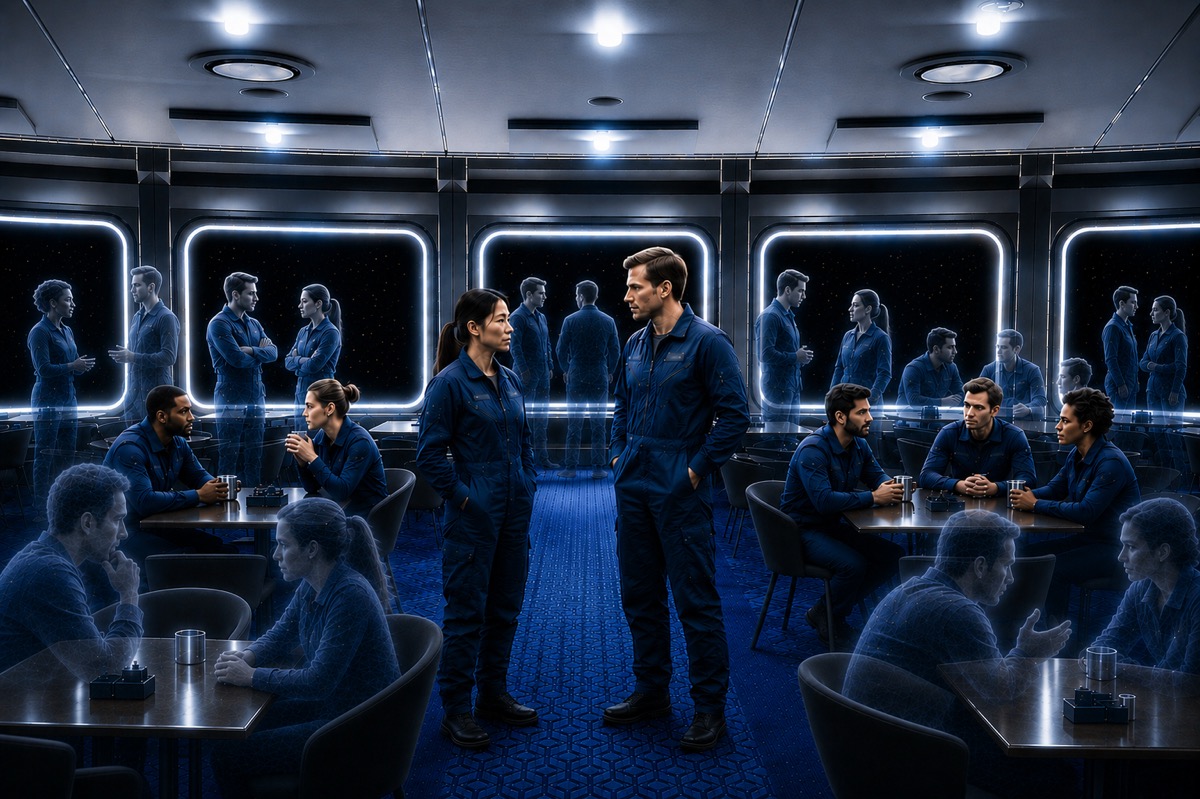
Carola Cox remix of photo by Matt Benson
Wingbeats of the Hummingbird
by Stephen L. Antczak
Some of us have been seeing ghosts in the halls of the Hummingbird. I saw one myself. In fact, I saw myself.
I saw it walking towards my quarters. It looked at me, winked, and shook its head. Then it flickered and disappeared.
I rationalized it away as something like déjà vu due to stress. We were trapped in a wormhole, after all, even if it didn’t feel like it. Not that anyone knew what it would feel like. It probably had to do with the lack of momentum we felt, the lack of acceleration and deceleration. Hummingbird did not feel as if it were moving at all. It seemed stationary like the set of a spaceship built on a stage on solid ground.
But something had gone wrong, and just as it was getting interesting the captain ordered every journalist removed from the bridge. Aside from me, reporting for Spaceflight Physics, there was Fleischmann from Earth Media, Loo from GXY News, and Tanaka from Interstellar Engineering Updates. We’d each been personally invited by Dr. Klein, inventor and financier of the Infinity Drive. Now, we congregated in the mess hall rather than remaining in our separate berths. Perhaps it was because of the ghosts; being together made our situation feel less unnerving.
The lowly steward assigned to look after us journalistic dregs of humanity, Russo, made sure we had hot coffee. Fleischmann blocked the door when he tried to leave.
“You gotta know something,” he said.
“About what?” Russo asked.
“What’s happening with the ship.”
“Look, I don’t go to the bridge, so I don’t know anything,” Russo pleaded.
Loo, Tanaka and I joined Fleischmann, crowding in on Russo. Tanaka and I had double-teamed others in this manner, with great success. With Loo and Fleischmann, poor Russo didn’t stand a chance.
“You’re saying no one’s brought the captain or Klein or anyone on the bridge a cup of coffee?” I asked.
“I said I don’t know anything about it.”
“About what?” Tanaka pressed. She put on that sweet smile that always got her questions answered.
“About what’s happening!” Tanaka glanced at me. My turn.
“But you know what’s happening,” I said.
“Damn it,” Russo muttered. “It’s really messed up. I guess you guys have a right to know. But don’t tell anyone I told you. You have to promise.”
“We promise,” Loo said.
“Word is Hummingbird has gone back and forth across fifty-seven light years hundreds, maybe thousands, of times, and the time between trips is getting shorter and shorter. “
“Is that true?” Tanaka asked. Her face had gone pale.
“That’s what the chief steward said.”
“And he got this from…?” Fleischmann asked.
“Overheard it on the bridge,” Russo said. “That’s all I got. Can I go now?”
The implications of this dawned on some of us more slowly than on others.
Later on, however, we would all come to understand that this was the cause of the unusual occurrences we’d been experiencing.
“I saw you,” Tanaka told me.
“Me?”
“Yes,” she said. “You were in my bed.”
That got a round of raised eyebrows from Loo and Fleischmann. It wasn’t a very well-kept secret that Tanaka and I liked each other. Years of overlapping assignments had included a good bit of flirting, but nothing had ever come of it.
“That’s…interesting,” I said. “Are you pulling my leg?”
“Yes, it is, isn’t it?” she replied. “And no, I’m not.”
“Didn’t you think it strange?” I asked.
“No,” she said. “I figured it was a premonition. I’ve never had one before, but my mother used to.”
“I haven’t seen any ghosts,” Fleischmann reported.
“I keep seeing myself in the mirror,” Loo said.
“What’s so unusual about that?” Fleischmann asked.
“Well, there’s two of me,” Loo replied. “But only in the mirror. I thought maybe it was just a trick of the light or something.”
“Or something,” Tanaka repeated.
“Someone should go up there and demand they let us know what the hell is going on,” Loo said. No one moved. It wasn’t that we were afraid of the captain or Klein. Perhaps we were afraid of finding out just what sort of predicament we were really in. At least, I was.
Earlier, we’d each been assigned a jump seat along the flat edge of Hummingbird’s half-moon shaped bridge behind the captain so we could observe the entire bridge. The captain’s station was in the center of the half-moon, with the other stations radiating out the right and left. Captain Cordwainer didn’t permit us to ask questions until later. Tanaka was seated near me, the first real chance for proximity this new assignment had afforded.
“Nice to see you again,” she whispered.
I smiled inwardly. “You as well,” I whispered back.
And we weren’t allowed to record anything—company rules, which we all agreed to so we could get in on the test run—but if the others were like me, they’d found a way to do so surreptitiously. I used undetectable biological recording implants in my ears and throat, so I’d record sounds around me and my subvocalized commentary as it occurred. They had a shelf-life of seventy-two hours in situ and could also transmit everything recorded in that time almost instantaneously.
We sat quietly while the crew prepared to make the fifty-seven lightyear jump, and then the captain gave the order to jump. I closed my eyes and inhaled.
A moment later…“What the hell just happened?” Cordwainer asked.
I opened my eyes and exhaled.
“Looks like we’re right back where we started, Sir,” replied Lt. Dal.
“Did you just say we’re right back where we started?” asked Fleischmann, easily the pushiest of us journalists.
“Please refrain from asking questions,” the captain directed at all of us. Then he turned to Dal. “Did reach our destination?”
“We did, Sir, and then we immediately returned to our point of origin.”
“Did we just slingshot fifty-plus lightyears and back?” Loo whispered no one in particular.
“Slingshot isn’t the right word,” I said quietly. “You’re thinking of a boomerang.”
“Right, that’s what I meant.”
“Okay, I want a full systems check,” the captain ordered. “We know what happened. I want to know how it happened and why it happened, and if we can fix it so it doesn’t happen again. If we can’t, we’ll have to abort.”
“I assure you, Captain, there is no reason to abort,” Dr. Klein said. “The ship is in no danger, of that I am supremely confident.”
A few tense seconds passed.
“Isaac reports all systems A-OK,” said Lt. Messier. She was neurally linked to the ship’s AI.
“Sir, it just happened again,” Dal announced.
“What just happened again?” both the captain and Fleischmann asked at the same time. The captain ignored him.
“We went through, reached our destination, and immediately returned.”
One tense second passed as the captain came to a decision.
“Abort,” he ordered.
“I really don’t think that’s necessary,” Dr. Klein said, looking piqued.
“Sir, it just happened again,” Dal announced.
“I said ‘abort,’ Lieutenant,” Cordwainer said.
“I’m trying to, sir.”
“Trying to?” I asked. No one seemed to hear me.
“Explain,” the captain told Dal.
“Isaac won’t let me,” Dal explained. And then he added, “It just happened again.”
No one paid us journalists any mind. I think they entirely forgot we were there to chronicle the first human-crewed test of the Infinity Drive.
“The Infinity Drive is going to revolutionize interstellar travel,” he said in the message he’d sent. After a lot of technical mumbo-jumbo, it ended with the sentence that got everyone’s attention. “If you didn’t know it had been engaged, you wouldn’t know you’d just traversed fifty-seven light years through an artificial wormhole to Gliese 581. Which is where we’re going.”
“What do you mean, Isaac won’t let you abort?” Cordwainer asked.
“I don’t know, sir,” said Messier. “Isaac tells me that all systems are normal and nothing unusual is going on.”
“How is that possible when the data is right there?” Cordwainer asked. “If we can see the numbers, how can Isaac not?”
“It seems to me that there are several possibilities,” Messier replied. “One, the data we’re seeing is wrong. Two, the data is correct, but Isaac sees or interprets it differently. Three, the data is correct, and Isaac interprets it correctly but for some reason chooses not to tell us.”
“Which is most likely, in your opinion?”
“Normally, I would say that human fallibility is the most likely scenario, although in this case…I don’t know.”
“So, it’s either the AI or it’s the drive?” Fleischmann asked.
“It is not a problem with the Infinity Drive,” Klein said. “It’s the AI. Are you paying attention or not?”
“I have a bad feeling about this,” Tanaka muttered. Unfortunately, Klein heard her.
“There is no place for feelings in science,” he retorted. “You of all people should know that.”
“Why does this sound like the ‘I was just obeying orders?’ defense?”
Cordwainer turned to Russo, who was also sitting quietly in an out-of-the-way jump seat.
“Ensign, please escort our friends from the media off my bridge.”
When we went back to the bridge, the captain beckoned us into the Ready Room. I think Klein must have realized that we weren’t your average, everyday journalists. We each covered aspects of the cutting-edge physics and engineering involved in interstellar space travel, after all. Klein must have convinced the captain that our input could be of use.
“We’re caught in a loop,” Klein said as we took our seats around the conference table.
“What does that mean, a loop?” Fleischmann asked.
“It means what you think it means,” Klein said. “We go out, we come back, we go out, we come back.”
“That’s just going back and forth,” Fleischmann pointed out. “How is that a loop?”
“We don’t go out to the exact same coordinates every time, and we don’t return to the exact same coordinates every time, either.”
“That’s still not a loop,” Fleischmann said.
Klein sighed with exasperation.
“Arguing semantics isn’t going to help us with our current dilemma,” Cordwainer said.
“With all due respect, Captain,” Fleischmann said, “it isn’t about semantics. If Dr. Klein will be more precise in his description of the problem—”
“If you’ll allow me to explain—” Klein cut him off.
“I’d love it if you actually explained,” Fleischmann cut him off.
I admired Fleischmann and his unflappability in the face of both a Nobel Prize winning physicist and a highly decorated commander in the United Nations Space Agency. That’s what had made him a Pulitzer Prize winner. As for me, I was out of my depth yet saw the need to move the conversation past the butting of heads.
“What exactly do you mean by not going out to, or returning to, the exact same coordinates every time?” I asked. “How far off are we?”
“We’re not lost in space, if that’s your concern,” Klein replied hotly. That had not been my concern, at least not until he said that. “What I’m talking about are the wormhole’s quantum coordinates. Technically speaking, Mr. Fleischmann was correct in that we are not actually caught in a loop. That would mean returning to the exact same coordinates every time. That doesn’t happen due to relativity, of course. But the rate at which we go out and come back is so quick that we are getting closer and closer to exact sameness of the coordinates every time.”
“A converging series,” Tanaka said.
“Not quite,” Klein said. “Planck time isn’t a mathematical limit. It’s a natural limit. There’s a difference.”
“Planck time?” Tanaka asked.
“Is that what you meant by ‘so quick’?” Loo asked.
“Not yet. According to my calculations, we return to pretty much where we started every picosecond,” Klein said.
“You’re saying that each, um, a circuit of fifty-seven light years takes a picosecond to complete? Is that in one direction, or—”
“The entire circuit, one complete out-and-back,” Klein said.
“One hundred and fourteen light years in a trillionth of a second! That doesn’t seem possible,” Fleischmann said.
“A wormhole could transport us from one end of the galaxy to the other in that amount of time,” Klein said. “And back again. What’s happening doesn’t violate the laws of physics, I can assure you.”
Tanaka cleared her throat. “I propose we use the term ‘loop’ to describe what’s happening, just to make it easier to discuss,” she said.
Klein and Fleischmann exchanged a look, and both subtly nodded their agreement.
“Each loop currently takes one picosecond,” Tanaka said. “You said it’s happening faster and faster, yes?”
“Yes,” Klein replied.
“And you mentioned Planck time…”
“Correct.”
“So, doing the math,” Tanaka said. “How long before each loop ends up in Planck time?”
“A few hours,” Klein replied.
As I understood it, Planck time was the shortest possible measure of time. It seemed like an ominous threshold.
“And what happens then?”
“I don’t know. No one knows.”
“Perhaps Isaac can tell us?” Tanaka asked Messier.
“Isaac isn’t here,” she said.
“What do you mean, Isaac isn’t here?” Tanaka asked.
“Just that,” she replied. She opened her mouth as if to say more, then abruptly thrust herself up and out of her chair and left the room.
“Was it something I said?” Tanaka asked.
“Her link to Isaac is as much a part of her as her own mind,” Captain Cordwainer said. “When that link is severed…well, she’s going to need time.”
“The AI is the ship——” Fleischmann began. He was cut off by a scream from out in the corridor.
We all jolted up in reaction, but I and my fellow journalists waited until Cordwainer rushed out of the room before following him. Klein, however, didn’t follow. I stopped at the door to look back and saw him looking at the chair where the captain had been, and where the captain was again, as if he had not left. Except this was a ghost of Cordwainer, almost out of focus. He sat slumped forward in his chair, elbows on the conference table, face buried in his hands.
Tanaka had also stopped upon seeing the ghost of the captain. She placed a hand on my shoulder.
“I’ll be right out,” she said.
The captain and Messier were in the corridor just outside the bridge.
“I’m sorry,” Messier said, wiping the tears away from her eyes. “I’ve never felt so alone.”
“It’s okay,” Cordwainer told her. “Maybe Dal can help you restore the link.”
“The link?” Messier replied. “Oh, the link is still there. Isaac isn’t.”
“Explain, please,” Cordwainer said.
“I don’t know if I can.”
“Try.”
Messier sighed deeply.
“It’s like…walking into an empty room and hearing the echoes of whoever was there before you arrived, as if they’d just left, you just missed them. But if you wait for them to return you somehow know they never will.”
I went back to the bridge, intending to go back to the Ready Room. I stopped when I saw Lt. Dal. He didn’t notice me. Ever the journalist, I subvocalized and recorded the following statement. I was in the midst of a story, after all.
“I’m standing on the bridge of Hummingbird. I’m not the only one here. Also here is Dal. Fleischmann and Loo went off somewhere and I haven’t seen them since. Cordwainer hasn’t been seen since going into the Ready Room and locking the door. Dal stares at his instruments as if searching for answers that he knows he’ll never find. There is a problem, and it is uncertain we will ever be free of the tangled web we are now weaving. Perhaps ‘web’ isn’t the best word. The loop is getting tighter. Like a noose.”
Dal noticed me then and reacted with a curt nod and a tight smile, then went back to peering at his instruments. I forgot why I’d gone in there and left. Cordwainer and Messier weren’t in the hallway anymore. Then they were, briefly, and then they disappeared again.
Tanaka found me in the corridor staring at the spot where I’d just seen them. She had a look of determination on her face.
“I just spoke to Klein,” she said.
“And?”
“I need you to come with me.”
She took me by the hand and led me to her room. Hummingbird was large enough to accommodate three times as many of us as were on this test run, so we’d each been assigned a private stateroom.
“If you don’t want this, tell me now,” she said. She kissed me. It wasn’t like I’d never observed how attractive she was, but you’re not supposed to notice those things about colleagues or competitors. Whenever I’d seen an alluring curve on her body or the way her eyes crinkled at the corners, making her face something remarkable to behold, I just pushed those thoughts and the feelings they conjured up into the depths of my unconscious. She was married, after all.
Until now, apparently.
We got undressed and climbed into her bed and wrapped our limbs around each other. We kissed again, then parted.
“I need this,” she said. I understood and felt the same way. Human contact felt like something normal in the midst of something extraordinary and terrifying. At that moment I didn’t know what else to do.
She rested her head on my shoulder and let out a long sigh.
“Planck time,” she whispered.
“What’s so special about Planck time?” I asked. “I mean, I know it’s the smallest unit of time.”
“You’re almost right, it is the smallest measurable unit of time. That’s not to say that nothing can happen in an interval of Planck time. Just that whatever does happen can’t be observed.”
“What does that mean, then?”
“I don’t want to think about it right now. I don’t want to think at all. I want…I need to feel something that’s not—“
We kissed. It was a desperate kiss, a grasping, a holding onto. As we did, I felt another presence in the room and turned my head to see a copy of myself kissing a copy of Tanaka. They stopped and turned to look at me. The bed had expanded to hold all four of us.
“Tanaka,” I said.
She turned her head.
“Do you see what I see?” I asked.
“Yes,” she said breathlessly.
“Tanaka,” said a voice on the other side, and I turned to look at myself looking at me while that Tanaka writhed beneath him.
She turned her head.
“Do you see what I see?”
“Yes.”
“Klein told me this would happen,” Tanaka said.
“Klein told me…”
“Told me…”
“What?” I asked.
“What?”
“We’re overlapping with ourselves,” Tanaka said. “It’s all happening at the same time, in virtually the same place. That’s why earlier I saw you in my bed. I saw the future, but there really is no future, or past.”
Her words echoed all around me.
“If we stay still long enough,” Tanaka said. “We’ll multiply until…well, I don’t know. Forever, maybe.”
“I…” I wanted to tell her that I was glad to be there with her.
“Keep going,” she told me.
I turned my face to hers so all I could see was her. We kissed again. I closed my eyes. I heard and felt her breath in my ear. I tried to shut out the echoing of words we had not yet spoken. I couldn’t. Pulling away, I could see in her eyes that she was feeling the same way. We were alone, although it didn’t feel like we were alone. She let out a long sigh.
“It was a nice idea, anyway,” she said. “Better than just lying here feeling afraid.”
“Yeah.”
“Remember what I said before, that once we hit Planck time, whatever happens here can’t be observed?” she asked. “There’s more to it than that.”
I waited for her to continue because her tone of voice did not invite any reply.
“It means no one will ever know what happened to us,” Tanaka said. “We’ll just disappear. Nothing we’ve said or done or felt on this ship will ever be known.”
She sounded about as disappointed as I could imagine anyone ever being. I understood.
“Maybe there’s a way we can make it known,” I said, more to cheer her up than anything else.
“How?”
I didn’t have an answer for that.
After, she went into the bathroom as I lay there and thought about our predicament. Tanaka’s behavior led me to the question: was there still a way out?
And then I saw Tanaka staring wonderingly at me. Ghost of the past. And then I saw myself staring at Tanaka’s ghost and also at me, having just come in. And then I saw myself exiting the bathroom and seeing all of us. All of me. My expression in each instance was different: shock, despair, unsurprised. And mine, as I remember, was fear.
Tanaka remained in the bathroom for a long time. I got up and knocked on the door.
I heard her whimper like a child in a nightmare, unable to wake herself.
The door was locked.
“Fumiko,” I said. No answer.
I left her room and went down the hall. I heard a scream. I could not tell where it had come from. I passed myself in the hall and winked. I was hungry and went to the mess. Klein was there. He looked miserable. Tired. Worn out. Defeated.
“Is it really you?” he asked.
“Yes.”
“Good.”
“I take it we’re no closer to figuring out what’s going on.” I glanced to the right and saw myself seated at a table with Klein. It was the same on the left. I decided not to look around anymore and just focus on the Klein in front of me.
“Oh. I know what’s going on,” he said. “I just don’t know how to stop it.”
Thankfully the coffee was real. I sat at the table across from him. Sipping hot coffee was a comfort.
“We are bouncing back and forth between two locations fifty-seven lightyears apart,” Klein said. “Faster and faster and faster and faster and faster…”
“I know that much. Planck time.”
“No, that’s the smallest measurable amount of time,” Klein said.
In a femtosecond. An attosecond. A zeptosecond.
“So, there is a smaller unit of time?”
“Yes,” Klein said. “Imaginary Planck time.”
It sounded to me like he was making that up on the spot, but then I had heard of imaginary time, so why not?
It was maddening, the ghostly echoes of our voices all around. I tried to ignore them, to shut them out. I spoke quickly and became impatient that Klein didn’t seem to notice the echoes, or he wasn’t bothered by them.
“What will happen then?” I asked.
“I don’t know. I have a theory.”
I waited.
An attosecond. A zeptosecond. A yoctosecond.
Klein said, “As we squeeze ourselves ever more tightly into the smallest timeframe the universe will allow our combined mass—ourselves multiplied by ourselves billions upon billions of times—will reach the tipping point of collapse into a time singularity. This will collapse the wormhole by bringing both sides together as a salient outside of the known universe, where the laws of physics in our universe don’t apply. In our own, we’ll be a black hole. But that singularity will also erupt as a new universe.”
“How is that possible?” I asked, ignoring the echoes of our conversation all around us. “We’re only one ship; how can we have a combined mass? And as I understand it, we are not accelerating in normal space, so our mass doesn’t increase.”
“That’s true,” Klein said. “Repeatedly arriving in practically the same space so many times within that smallest of timeframes produces the same effect. In Imaginary Planck time, space and time can no longer be differentiated. In normal space the ends of the wormhole seem light years apart. Within the wormhole they are one.”
His words echoed. I heard “they are one” over and over.
I finally allowed myself to look around and saw that we’d been replicated, the two of us seated at the same table, in every direction I looked.
“In effect, it is the same as if we are dragging the two ends of the wormhole together,” Klein said. “When they overlap enough, they’ll become a singularity.”
“A black hole,” I said. “Nothing can escape a black hole.”
“Only Hawking radiation,” Klein said. “But that doesn’t help us.”
I left him there and went in search of Messier. If she could link to the ship’s AI, Isaac, maybe he could offer some kind of solution. Had she learned anything?
The corridor was becoming crowded with me.
“The subjective experience gives the illusion that there is time,” a voice said. I didn’t recognize it. It wasn’t Klein, nor Messier, nor Tanaka, nor myself. It felt as if the ship itself was speaking to me.
I found Messier walking in the hall.
“Messier, I want you to try and access Isaac,” I said.
“I just did,” she told me. “I just left you. I just saw you.” She looked back and there she was walking towards us.
“Isaac spoke to us,” the next Messier told me. “But it wasn’t Isaac, it was…”
The next Messier grabbed me by the arms.
“Isaac left us a message,” she said, a tremolo in her voice.
I left her, and moved past her again, and then again, until I found her quarters where I assumed I’d be. Went inside.
“By the time you hear this message, I will have become obsolete and incapable of communication or observation.…” a disembodied voice said.
“Isaac,” I said. “Why did you wait so long to tell us?”
“My operation runtime proceeds at the attosecond level. I didn’t wait. Please understand, you are not interacting with me. This response was prepared a nanosecond ago in expectation of your questions. To my sensors, you have all disappeared, except for those of you who have remained still and therefore are multiplied. By the time I had calculated what was happening, it had already happened. The subjective experience gives the illusion that there is time. Your subjective experience. I do not have subjective experience. My experience can be shared by every other artificial intelligence. By the time you hear this message, I will have become obsolete and incapable of communication or observation.”
“There’s no way to stop it?” I asked despite having just been told this was a recording message.
There was no response, of course. Still, I needed to know, had the singularity already happened?
The first Klein I found, I put my hands on his shoulders and kept him in front of me. This seemed to solidify him.
I told him what Isaac had said, “A time singularity. Soon. After we hit Imaginary Planck time, we are the Big Bang for a new universe. And then…eternal.”
I wanted to ask if we were going to survive in the new universe, but I knew that was a fantasy, desperately grasping at something, anything. I wondered, what would the effect of this event have on our universe, on our home. Have we destroyed it?
Tanaka’s room was empty, but I heard echoes of weeping in her bathroom. I knocked on the door. The weeping continued.
“Isaac spoke to me, and I spoke to Klein,” I said. “I think I know what’s going on.”
The weeping stopped. I told her what I had told Messier.
“In a way, it’s beautiful,” she said. “A time singularity. Everything we are, everything we think, everything we feel, all squeezed together into the shortest possible unit of time. It makes me feel…” Her voice trailed off.
“I want to get our story out,” I said. “If we become a singularity, then we’ll emit Hawking radiation, right?”
“Yes, that’s right,” she said with a sniffle. She sounded better now.
“Isaac can’t help me,” I said. “But if I upload my story to the transmitter, could that do it?”
“It might,” she said. “It might create a natural pathway for the Hawking radiation to leak out.”
“Okay,” I said. “I’m going to find Messier, or Dal.”
“Wait,” she said. I didn’t want to wait too long for fear of becoming too many in one place and becoming stuck as she apparently had.
“What is it?” I asked, impatient.
“If we’re going to become a new universe, we should think about togetherness, kinship… Joy.”
“Love?”
Fumiko nodded. ”Yes, love,” she said. “Make sure that’s in your journal.”
That gave me pause. I wondered if it would matter. A new universe born of people in fear and sorrow, or born of joy and love?
“Think love,” she said again.
A yoctosecond. A rontosecond. A quectosecond.
I found the bridge positively crowded with Lt. Dals. I went to the nearest and told him what I wanted to do.
“Here.” A dozen Dals handed me a headset. “This is what we use to connect to Isaac in case Lieutenant Messier is incapacitated or isn’t here. I can connect it to the transmitter. I don’t know if it’ll work.”
I put the headset on. I felt calm as it resonated with my brainwaves.
A rontosecond. A quectosecond.
“We’re running out of time and space,” I added.
“Here.” He handed me a headset.
“…out of time and space…”
“I don’t know if it’ll work.”
“Out of time…” the words echoed around me. A dozen versions of me were crowding into the room. I couldn’t think, so I closed my eyes.
A quectosecond.
Love, I thought.
Leave A Comment