
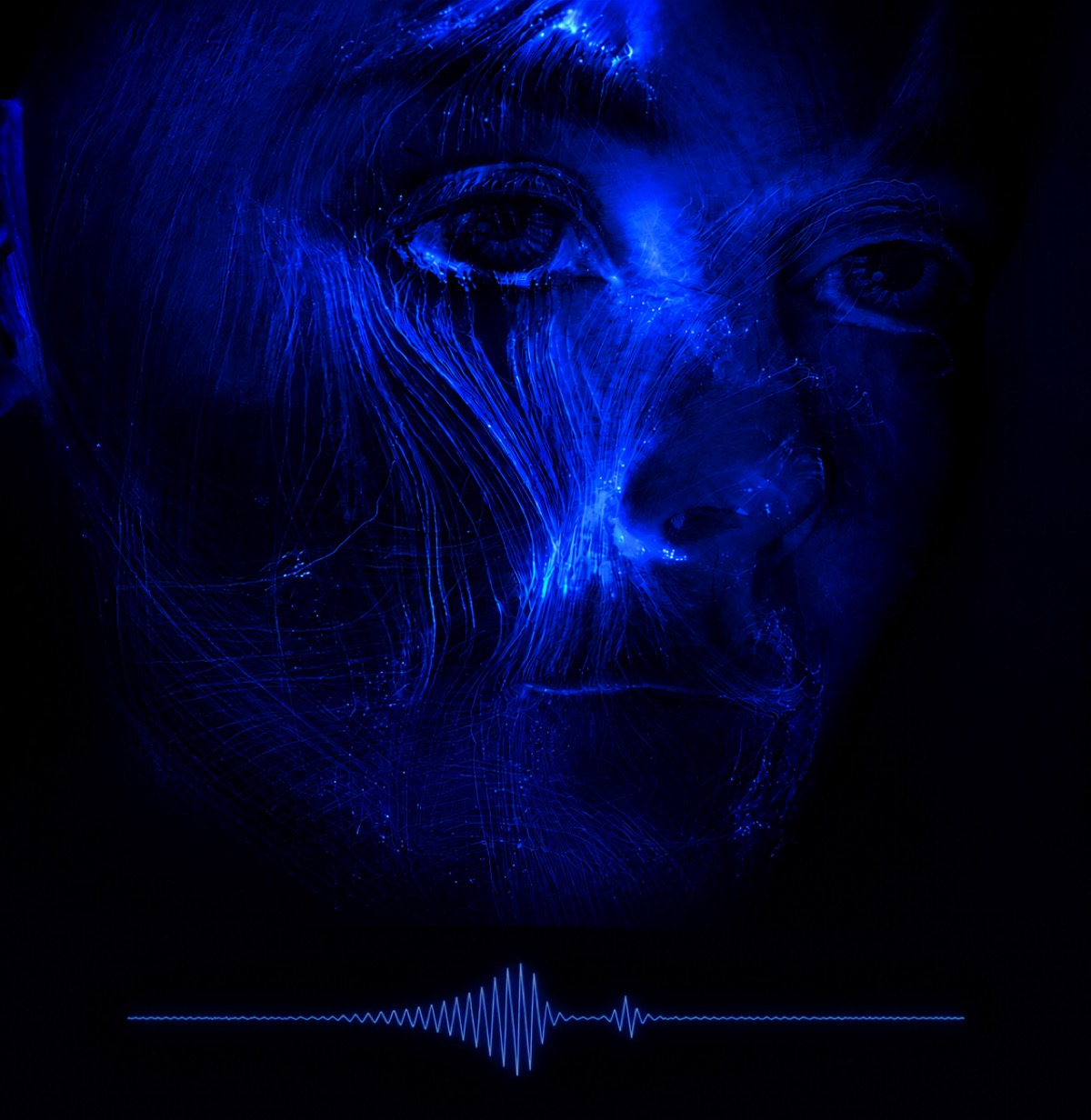
Remix of photo by Compare Fibre
When You Can No More Hold Me by the Hand
by Linda Christian
Karl sat at the Aragons’ dining table, a soft cloth spread under his gear and the Echo prototype so they wouldn’t scratch the pristine, gleaming wood. He needed one more sale, but there were no buyers in the usual dark corners of Oasis Orbital Station. Only the Aragons. And so Karl sat at an uncomfortably expensive table, across from a grieving middle-aged couple who were slowly, silently processing his sales pitch.
Alana Aragon wore a navy-blue dress that hung perfectly on her frame, without a wrinkle or fleck of lint. Her hair was similarly impeccable. Something about her appearance made Karl sure she had picked out the table. Together, they were an advertisement for the type of wealth people insist on calling understated. Karl had never agreed with that assessment. It was pretty glaring.
Hector wore expensive clothes too, but in the rumpled way of a person who wasn’t preoccupied with appearances. Or who wanted others to think he wasn’t. It felt like a negotiating tactic—an attempt to put Karl at ease and give Hector the upper hand. Instead, it made Karl irritable and wary.
As long as they have the money.
And the Aragons certainly seemed to. Every workspace and cabin Karl had seen on the station so far, even the nicest, was a featureless box, functional and plain. He’d never been inside one of these upscale units before. The floors were a fine, dark wood, either real or perfectly imitated. Ornamental moldings ran along the walls and outlined an immense screen masquerading as a window. It was all so convincingly suburban that Karl half-expected to see a yard or trees outside the “window”. Instead, the screen projected a crystal-clear image of their actual surroundings—the vast darkness sprinkled with stars, the curve of the ruddy planet visible along the screen’s edge.
“Will the information on her chip really help that much?” Alana said. “You have the communication files from our home and her devices. Most Echoes are made from nothing more than that.” She gripped a small plastic vial in her hand and looked at Karl, skepticism and hope mingled in her red-rimmed eyes.
It was the hope that caught Karl’s attention. He recognized it. Understood it. He could almost see the raw grief swirling behind it. He didn’t relish the idea of dragging that grief out into the open, but her hope was his ticket to a successful sale. It had to be. It was the only way he could afford to get off the station before the coming crackdown.
Karl took a deep breath before asking the question he’d planned to avoid. “Your daughter? What was her name?”
Alana’s eyes dropped to her hands, folded in her lap. “Liliana,” she whispered.
Karl nodded and repeated the name softly, almost to himself.
Hector’s attention was focused on Karl, but his face was closed, unreadable. He shifted in his seat before speaking. “Certainly this prototype is far from the real thing. Too far. But using her parole chip to retrieve security data is risky. If you’re caught, we’ll be out of options.”
“Because you’ll be at risk too,” Karl said.
Hector waved the comment away with a flick of his hand. “That’s what lawyers are for. But if security confiscates the chip, we won’t have another chance. Right now, I have other options, other people. They may not have your credentials, but they’re not asking for the chip. If you’re caught, those options evaporate.”
If Karl was caught, Hector’s lawyers would give him up in an instant, if it meant leniency for their clients. Possessing prohibited tech was bad, but breaking into the security network to steal data was far worse. No hefty fines or short-term station lockup for Karl. It would be a prison cell on the planet. Which meant underground. Years, decades maybe, before he saw the sky again. If he ever did.
“I won’t get caught,” Karl said. “And you could hire someone else, but I’m more experienced than anyone on the station.”
Hector leaned forward and glared at Karl. “Experienced working for security. This is different.”
Karl clenched his jaw and bit back the irritation threatening to spill out. What more did the man expect? References? Karl’s mind worked furiously, attempting to translate his exasperation into more agreeable vocabulary.
Before he could do that, Alana’s voice cut through his rising tension. “And the Echo? Will it be like having Liliana back?” Her voice cracked on the last words, and she coughed politely as though covering up that lapse. The grief in her voice tugged at Karl.
Normally he kept his own emotions out of negotiations, but he could feel the mask slipping. When it did, something was going to show. Better for it to be his own grief, than his growing frustration. Or worse, greed. He turned away from Hector to meet Alana’s gaze instead, the pain and empathy in his eyes no less real for its usefulness.
“I can do that for you, Alana. I can create an Echo so convincing that sometimes you’ll forget she’s gone,” Karl said. “But only if I have Liliana’s chip. With it, I can access the data in the security archives. Without it, I have to rely on second-hand communications data. An Echo like that is barely more than a standard AI with her name and face tacked on.”
“No.” Alana’s voice was steady again. “We don’t want that.”
“Of course not. You want more,” Karl continued. “You want her personality, her sense of humor. Less endearing qualities even. Was she sarcastic? Argumentative?”
A sad smile spread across Alana’s face. “When we argued, we could always tell if she decided we were right. Before she would admit it, her anger would flare up like she was, I don’t know…” Alana shook her head.
“Feral,” Hector suggested. “Like a wild cat.” He chuckled to himself and smiled.
It was the first hint of Hector’s emotions that Karl had seen. When Hector reached over and took Alana’s hand, Karl felt the tension seep out of his own muscles. He was close. He knew it. And then he—and Denny—could get off this station for good.
“You’ll want all of that, all of her, in the Echo,” Karl said. “You know how accurate security’s surveillance algorithms are.” Everyone in the company knew, even pampered executives who would never set foot in a security office. The sheer volume of data collected by a surveillance chip and mirrored back to the analysis center resulted in near-perfect predictions. Security seldom left the office. They just sent warning pings to parolees and watched them back off.
“You can promise that level of accuracy?” Hector said. “A precise Echo of our Liliana?”
“Everything I need is in the restricted archives. With the chip, I can access it all. And I can do it without leaving a trace. I’ve done it before.”
Karl let his words hang in the air, his final attempt to sell them on his expertise. He could see how much they wanted the Echo and was sure now that they would agree. And clearly, they understood the chip’s importance. The coroner wouldn’t give them their daughter’s surveillance chip for free. Falsely claiming it was destroyed and failing to return it to authorities carried a substantial penalty, and therefore a substantial fee, which they must have paid. Karl let the silence stretch out and waited for them to hand him the vial.
He made his way out of their exclusive neighborhood, meandering back toward the utilitarian halls of his busy sector with a long and circuitous route so he could untie the knot in his thoughts. He’d assured the Aragons that he’d be working tirelessly to complete the improved program. And it was true. The faster he worked, the less time they would have to reconsider. He was satisfied with the arrangement, but something about the meeting stuck in his head and rankled him.
Other options, Hector had said. Had he already talked to someone else? Tried to hire them? That could be a problem. And if he had let slip Karl’s involvement, that would be worse. Karl needed to know.
He quickened his pace and turned onto the main thoroughfare back to his unit.
“Can’t you take it out or turn it off?” the imposing man said. “I’m tired of the police hitching a ride in my brain. Aren’t there laws against that?”
“Not on Oasis Station.” Karl answered without a glance, his attention focused on the screen in front of him.
Karl’s workshop was a small but efficient space, well-lit and smelling faintly of the cleaning solvents he’d applied moments before his client’s arrival. The room was lined with shelves on which assorted electronics were neatly arrayed. Most were shiny and new, their sleek, fashionable shapes providing little clue as to their function to most visitors.
Except for the complicated machine that sat between Karl and his client. It was cumbersome and bulky, its design outdated and almost aggressively bland. A clear rejection of consumer-oriented aesthetics, it instead exuded a relentless bureaucratic efficiency. Karl sat on one side of it, checking the data on the monitor. His client sat the other, wired to the machine through a scattering of sensors attached to his skin. His foot bounced nervously. Good.
Karl wanted him gone quickly so he could check up on Hector, find out if he really had talked to someone else about the Echo, or if that was just an idle threat. Karl had considered cancelling this appointment, but the client was already on his way. More importantly, Karl needed these security assignments to go smoothly. He didn’t want his employer checking up on him or even thinking about him. Not now.
The man—Karl had already forgotten his name—scowled and scratched at the skin on his neck near one of the sensors. “So, security can just do whatever they want?”
“Some of the old Terran countries restrict police power.” Karl said, “And a few of the stations farther out in the system. But these mining concerns are purely corporate. No limits for them, my friend, only rules for you. And the corp says if you break the rules, you get a chip.”
“Too many rules,” his client grumbled.
“And new ones all the time,” Karl said.
Karl typed a quick non-technical summary into the form, then detached the sensors from his client. “Results sent to your parole officer and to you. Everything performing as required.” He began wiping down the sensors, his eyes on his work. He hoped the client would get the idea and leave without more talk.
Instead, the man stood and surveyed the room like he was taking inventory. “You’re not official, right? Just a contractor?”
“That’s right.”
The man nodded and studied Karl before continuing. “So let me ask you, hypothetically. Could it be done? Turn someone’s chip off so they can get off-station. They’d probably charge a lot for that, right, the ones who’d do it?”
A huge paycheck just to deactivate a surveillance chip was a tempting thought. Probably fifteen minutes work and then make a break for it himself. Certainly, Karl’s day job wasn’t going to make him the money he needed, and the Aragon deal suddenly felt precarious. But no matter how he imagined the man’s proposal playing out, it didn’t end well.
He shook his head. “Money’s not the issue. If your chip’s transmission cuts out, security knows instantly. They shut down the transport terminal and search until they find you. And then you’re back in lockup, along with whoever helped you.”
The man grunted and turned without another word. He shoved the heavy door open and stomped out of Karl’s workshop into the wide hallway. Karl could see a scattering of pedestrians passing by, hear the buzz of their conversations and the electric whir of the carts that sped down the center of the thoroughfare. Then the door began to swing shut.
He watched its sluggish progress intently. It took only nineteen seconds for the door to close—he’d timed it once—but it was long enough to calm him, his breath slowing to match its pace. For the final few centimeters, the door’s movement was almost imperceptible. Finally, it latched with a soft click, and Karl let out a long breath. It felt like arriving home at the end of a busy day, sloughing off the outside world and returning to his own.
Finally, Karl could think as he tidied up his desk, wiping down the sensors and tucking away the wires. He hadn’t had time to formulate a plan before the client’s arrival, and despite the several days required to finish the Echo, he needed to keep tabs on the Aragons. Their communications would have to be monitored, of course. But what else? Banking records, maybe.
A chime sounded from the darkened communications monitor across the room. Karl wheeled his chair over and turned it on. “These are client hours, Denny.”
“I don’t see a client. And I wouldn’t have called, if you hadn’t skipped our meeting.” Denny pointed a screwdriver at Karl. “You know I’m right,” he said with a smirk.
“I know you’re insufferable.” As always.
On the screen, Denny laughed in response and turned his attention back to the project in front of him. His room, like Karl’s, was full of computer components and half-built electronics. But where Karl’s was immaculate, his was chaotic, lacking any obvious organization. His face, too, was both like and unlike Karl’s. The same broad jaw and straight nose. But a pair of eyes as light as Karl’s were dark peered out from under his sharp brows, and his hair was thicker than Karl’s had been for almost a decade. Insufferable.
“We were supposed to talk this morning,” Denny said.
“I met with the Aragons. It went long.”
“So many meetings, so little money,” Denny said, shaking his head.
“I showed them the Echo, the prototype anyway. They’re taking some time to try it out.”
“You can’t trust these corporate types, Karl. They’re as bad as the crime syndicates. Two sides of the same coin, really.”
“There are no other leads,” Karl said. “They vanished when the news leaked about the upcoming enforcement sweeps. The Aragons are the only ones who still think they can get away with illegal tech.”
“Is that why you’re rushing them?”
“Rushing?” Karl said.
“You didn’t even wait for their shock to wear off.”
“They know what they want.”
“If you say so,” Denny said. “You told them how to keep the Echo undetected, right? At least under the current rules?”
“I know what I’m doing.”
“And you took my advice on your encryption upgrade, I hope? Talking about outlawed tech on a video call.” Denny shook his head and tsked. “That’ll get you in trouble.”
“Don’t worry, Denny. No one’s listening. Anyway, that’s what I pay you for, right?” Karl pushed his chair back to his desk, tossed the last of the sensors into a drawer, and focused his attention on his work computer.
“Did they at least give you the chip?” Denny said. “What did the girl do to get a surveillance chip anyway?”
“Haven’t looked at it yet.” Karl stared at his own screen, his brow furrowed.
“I bet it was smugglers. Bored little rich kid, travels a lot, slides right past security. That’s a prime recruitment target.”
Karl didn’t respond. The only sound in the workshop was the staccato tapping of Karl’s fingers on his keyboard.
“So, what’s wrong? Didn’t Aragon pay?”
“He’s paying,” Karl said. “But there might be a problem.”
Denny sighed. “I knew they’d be trouble.”
Karl spoke without taking his eyes off of his own screen. “I’m sending you some names. Professionals who do this sort of thing. Or could. See if any of them are connected to Mr. Aragon.”
“He’s replacing you?”
“Doubtful. But I think he talked to someone else. I need to know who. I don’t like him keeping secrets.”
“I know, right? It’s not like you’re a criminal. Or like the job you’re doing could get him fired or arrested. Why wouldn’t he tell you everything? It’s a fucking mystery, really.” Denny chuckled.
“Shit Denny, I don’t have time for this. Either help me out or call back later.”
“Alright, I’ll check the names. But what am I looking for? If he’s not firing you or refusing to pay, what’s the issue?”
“Check his banking. Search his communications. Look for disputes over payment. I need to know if there’s someone who thinks they deserve a cut, or who’s going to spook him before I’m paid. I need the money, all of it.”
“See, that’s the part I don’t get. I understand being angry, if someone’s trying to cheat you. But you don’t actually need that money to leave the station. You’re taking all these risks to make what? Ten times what you need for passage off?”
Karl’s attention was still focused on the screen and keyboard in front of him, but the creases in his brow deepened in response to his brother’s words. “I have tech I need to take with me, and it’s not exactly approved for export. There are places in the system where the laws are lax, but I need help getting it there. Help costs extra.”
“Help? You mean smugglers.” Denny shook his head. “You can’t trust those people, Karl.”
“I’ll be fine,” Karl said.
“But why? Just leave the tech and take the money. I don’t even know why you’ve stayed on this station for this long.”
“You needed my help.”
“I’ve been on my feet and out of trouble for a while now,” Denny said. “But you’re still in this dead-end job on this dead-end station. Anywhere else would be better.”
“It’s not that simple.”
“Why not?”
Karl sighed. “I don’t have time for this, Denny. If you won’t help with the Aragons, then end the call. We’ll talk later.”
Karl sat at the now familiar dark wood table. This time there were no tools or equipment cluttering the area in front of him. Just a low glass of fine whiskey. Hector and Alana preferred theirs neat, but Karl liked ice. Drops of condensation meandered down the side of the glass and seeped into the tasteful, sandstone coaster beneath it. Karl watched as the moisture soaked in, deepening the blush of dusty red swirls, a subtle reminder of the nearby planet and the source of their wealth.
He was supposed to be done with meetings. When he delivered the upgraded program, the Aragons had seemed satisfied, thankful to have their daughter back, or some semblance of her anyway. Then the payments had stopped.
“You said yourself the program’s impressive, far better than the prototype,” Karl said. “Why am I waiting on my money?”
“It’s not our Liliana,” Alana whispered, almost to herself.
“Or not as much as we hoped,” Hector said. “Some of her comments are out of character. Not wildly, mind you. But not what we expected.”
“I promised you the best Echo possible, and that’s what I delivered,” Karl said.
“It’s just, we were hoping…” Alana’s voice trailed off and she picked up her whiskey glass.
“We want you to make some changes. Adjust the algorithm,” Hector said.
“Adjust it how? That’s not—”
“We’ll give you some examples,” Hector raised his voice slightly, talking over Karl’s objections. “What we would expect her to say in certain situations.”
Karl was incredulous. “I can’t preprogram her responses. It’s an algorithm, not a script.”
“So, we just have to accept that this is how the Echo is?” Hector was louder now.
“The Echo isn’t based on requests.” Karl’s voice climbed to match Hector’s. “It’s based on what she actually did and said.”
Hector’s jaw was clenched so tight that Karl was amazed he didn’t hear a tooth crack. Getting pulled into a yelling match was not going to get Karl his money.
Before Hector could respond, Alana did. “She wouldn’t do what we wanted before, Hector. Why would it be any different now?”
“Look, people surprise you sometimes, right?” Karl spoke slowly, wrestling his voice down to a more polite volume. He looked each of them in the eye in turn. “To be realistic, the Echo needs to surprise you as well, at least within reason. A range of possibilities, yes, but limited. Based on the person’s previous behavior.”
“Like the hurricane predictions they do on Earth?” Alana said. “The sort that gets less precise the farther out you go.”
“Very similar.” Thankful for a less combative conversation, Karl explained that the Echo would never stray outside of its range, but within it there was room for variation. If there were a single, most likely path, they could not predict it beforehand. “You could restart the Echo, if you’re hoping for a different trajectory. But it will forget everything from its first run.”
Hector grimaced and shook his head. “So that’s the trade-off. We keep it on this path, even though she seems off, or we restart it and she loses memories.”
“Obviously, we don’t want that,” Alana said, a sharp edge on her voice.
“Obviously?” Hector said.
“We’ve been talking with her for a week now,” Alana said. “You want to take that from her?”
“I want her to be herself, not some almost, slightly off-track version.” Hector drained his glass and set it down with a thump. “We’ll decide when I get back from the surface in two weeks.”
Karl was not interested in this argument. They were drifting away from the business at hand, at least the business that was important to him. “I expect I’ll see my next payment before Hector’s trip then. It certainly sounds like you’re keeping the Echo, whatever decision you make about restarting it.”
Hector’s jaw clenched again, and for a moment Karl expected him to lash out. But then Hector nodded curtly and reached for the handheld that lay on the table.
While Hector was tapping at his screen, presumably initiating a bank transfer, Alana turned to Karl. “Is it possible to interact with the Echo on something other than a screen? Could it go on a robot perhaps?”
“The only robots allowed on-station are the helper models,” Karl said. “They’re not very life-like, if that’s what you’re looking for.”
Alana shook her head. “The face projections are always distorted.”
“It’s better to talk through a screen, like she went away to college or something. Video representations are more realistic.”
“Agreed,” Hector said, “and more flexible. It’s not stuck on a single robot.”
“True, but you need to be careful about networks.” Karl stared at Hector. How many times had he already explained this? Theoretically, the Echo could be kept on a home network, if it was disconnected from the public ones that scanned for prohibited programs. Realistically, few personal networks were safe if security decided to peek in. “Best to keep it off any network, even in your home. Stick with a single device and attach the drive directly.” He shifted his gaze to Alana. “Just not to a low-res robot.”
Karl waited for them to speak. He hoped their response would focus on the priority of network security or the timeline of their payments, not his clumsy reminder that their Liliana wouldn’t be going off to college anytime soon.
Alana stared into her glass. Then she nodded and looked up at Karl. “Do they ever figure it out? The program learns over time. So, if we leave it running long enough, will she figure out what she is?”
Now that was a question he hadn’t expected. It had occurred to him before, of course, but he’d never considered it too closely.
Karl raised his glass to his lips and sipped the whiskey. He could tell it was expensive. Not the cheap, chemical taste of his youth, but a rich smoky flavor. Peaty, that’s what it’s called. Not that he’d ever seen peat or even knew what it was exactly.
“Will she?” Alana repeated.
He put the glass back down and turned toward her.
“I’ve never heard of it happening. But…” He shrugged. “The technology’s not that old. Eventually, I wouldn’t be surprised to hear some Echoes do. If they have enough time, enough clues, and they’re clever.”
Alana glanced at her husband and gave a small nod.
“One last thing,” Hector said. “I know we agreed to destroy the chip when our transaction was done.”
“One less connection between you and me and the stolen data,” Karl said.
“We’d like it back though,” Hector said.
“No.” Karl shook his head. “If it’s ever confiscated, it can point back to me. That’s not a risk I agreed to.”
“We’ll pay for it, of course,” Hector said. “Ten percent of the total?”
“Ten percent? Do you know the penalty for infiltrating the security network?” Karl shook his head again. “No.”
“Twenty then,” Hector said. “If anything ever goes wrong with the Echo, we’ll want another chance.”
Karl sipped the last of his whiskey, giving himself a moment to think. His current plan was to have his tech smuggled away from this station and the nearby planet, but only as far as the nearest transit hub. That was all he could afford. He would have to pick it up there and take it himself on the final leg.
It was a risk, though not a huge one. Transit officials at the hubs were just glorified tax collectors. They didn’t want to deal with criminal detentions. Sure, they would snatch up a murder suspect, if they ran across one. Someone accused of a universally recognized crime. But tech restrictions varied widely across the system. Deciding among competing jurisdictions and dealing with legal complaints from squabbling governments and corporations if they got it wrong? Most transit officials considered that well above their pay grade. Most.
Twenty percent though? That might be enough to transport his tech all the way. No need for even the small risk that a handoff in a transit hub would bring. He could book passage straight through and be safe from any overzealous customs officials. If he left the station quick enough, giving the chip to the Aragons would hardly be a risk at all, would it? Still, it felt like a loose end that he shouldn’t leave dangling.
“Please.” Alana’s voice was brittle. “We need to know we won’t lose her again. Not ever.”
Karl felt queasy. I shouldn’t drink whiskey on an empty stomach. He looked up at Alana, and the despair in her eyes washed over him like something physical. Again, his stomach lurched.
Suddenly, he couldn’t endure their company for a moment longer. He needed to get out. To stretch his legs on a long walk home and settle his stomach.
“Twenty-five,” he said, hastily standing and putting down his glass. It sat off-center on the coaster, jutting over the edge, but somehow not tipping.
Karl walked out the door without waiting for an answer.
On the screen, Denny leaned back in his chair and sipped from a mug. “It’s a horrible idea.”
“You’ve told me. Several times.” Karl crossed his arms and glared at Denny, his own morning coffee forgotten on the desk beside him.
“I’m gonna keep telling you until you admit I’m right.”
“I agreed to return the chip. I don’t go back on my word,” Karl said.
Denny took another sip and then shook his head. “You don’t have to keep your word with crazy people, Karl.”
“They’re not crazy. They’re grieving.” Yes, their grief was exhausting, even a little unsettling if Karl was being honest. But Denny was missing the point.
“Yeah, they sound like paragons of mental health,” Denny said, his voice dripping with sarcasm. “Completely fucking stable, and definitely not letting this obsession derail their lives.”
“What would you know about it?” Karl could feel anger welling up. Dimly, he knew he was overreacting, but he couldn’t stop. “You’ve never lost anyone the way they did.”
Denny started to respond, but Karl kept going. “And don’t say Mom and Dad. That’s different from losing a young person. Someone with practically their whole life ahead of them.”
Denny threw up his hands. “OK, you’re right. I don’t understand. But Karl—”
“They just want to hold onto her a little longer.”
Denny leaned in closer to his camera, his face filling the screen. “Maybe it’s time they let go.” He held Karl’s gaze, obviously waiting for a response.
Karl’s heart thumped in his chest, but he could think of nothing to say.
Eventually, Denny leaned back and continued. “The fact remains, they’re not thinking straight, and you don’t need that extra money.”
“I need it to get my tech out of here.”
“No, Karl, you don’t. You’ve already sold the programs you made, and you don’t need backups. Why would you take any of them with you? Tell me.”
Karl was done with this conversation. He wished he could pull the plug on the screen and watch Denny’s face fade away. But he needed him. Specifically, at this moment Karl needed him to monitor dozens of communication channels, for anything that might get in the way of him or his tech getting off station.
“My mind’s made up, Denny. Drop it.”
Karl turned his back to Denny to face his own screen. He stared as he pecked away at the keyboard. He had a timeline now and a destination in mind. He pored through shuttle timetables and temporary lodging options, taking meticulous notes on prices and locations. All the while, he avoided looking over at Denny, who had gone mercifully silent.
It was only when Denny’s mug clunked down onto his desk, followed by the sound of typing, that Karl realized how uncharacteristic this lengthy stillness had been. Before he could formulate an opinion on that, Denny spoke. “Hey, Karl.”
“Still busy, Denny.”
“You’re gonna want to see this.”
Karl let out a frustrated sigh, but he pulled his attention away from his notes. “What is it now?”
“My system scans the security networks, you know? Alerts me if any key phrases show up.” Denny looked up at Karl. “Hector Aragon was detained when he reached the surface. Possession of, and attempting to export, contraband technology.”
“What?”
“Sounds like he took Liliana’s Echo with him.”
Karl pushed himself up from his chair and paced in the small area between his desk and the worktable where the communication monitor stood. “Damn it! I told him to leave the Echo at home.” Karl sat back down heavily and stared at the floor.
As his short silence transformed into a longer one, Denny spoke, his voice quiet but firm. “You need to go, Karl. He won’t be allowed to talk to his lawyers right away, but as soon as he does…”
“My drives are going off-station soon. I’m handing them over tomorrow. If the workshop’s not safe, I can stay somewhere else and leave after the handoff.”
“And if security’s searching the station for you by then? No. You need to destroy the drives, anything incriminating, and get on the first transport out.”
“My contacts can sneak me out. They smuggle people all the time.”
“Yeah, and sometimes they get caught. Or the company decides to trim costs by cutting life-support to the freight compartment you’re hiding in. Why risk it if you don’t have to?”
Karl leaned forward in his chair, his elbows on his knees and his head in his hands. “But if I go now…”
“You’ll have to leave some things behind,” Denny said.
Karl sighed. When he responded, his words were barely audible. “I’ll have to leave you behind.”
“Believe me, I’m not happy about it either. But it’s your only chance of getting out in time.”
“You don’t understand. I can’t lose you again.”
“I understand more than you realize. Again.” Denny spat out the word. “When was the first time? Isn’t it strange that I don’t remember?”
Karl looked up at Denny, surprise and caution mingled on his face. “What do you mean?”
“You know what I mean,” Denny said. “There are gaps in my memories. I didn’t notice it at first, but recently—”
“Of course there are gaps. No one remembers every moment of their life.”
“The way I was when I was young, I should’ve been in prison by now or dead. Instead, I’m here, working with you. But I don’t remember why I decided to change. I don’t even remember deciding to.” His voice trembled and he looked away from the camera. “I know what that means, Karl.”
Karl stared down at his hands lying uselessly in his lap. His voice was quiet. “I tried to save you.”
“Of course you did. You always watched out for me. But you couldn’t save me from my own decisions. Hell, I’m surprised I didn’t pull you down with me. Though if you stay here and get caught, it might just be that I did.”
“I’m OK with the risk, Denny.”
“Denny’s gone, Karl. You know that. You’ve got to stop throwing your life away for…” He shook his head and shrugged. “For whatever I am.”
Karl stared silently at Denny.
Not Denny.
Not really.
Of course, Karl knew that. But for so long he had averted his attention from this lie he had constructed and repeated to himself daily. That Denny was still alive.
Karl was frozen, unable to decide what to do, unsure if his shock was due to the revelation that Denny—not Denny—understood what he was, or that Karl was being forced to acknowledge it himself. “I just…I don’t know…”
“You’ll need to pack, whatever you decide.” The voice from the screen was calm and compassionate, a side of Denny that didn’t always show through the sarcasm and bravado. “You do that while I scrub your network and purge anything suspicious. That’ll slow down security if they start snooping.”
Karl trudged up the narrow stairs to his apartment. Barely thinking, he stuffed a random assortment of clothes into a faded, gray duffle bag. Nothing too personal though. Even in his distracted state, he knew he needed to look like a tourist, not a fugitive.
Back in his workroom, Karl set the duffle on his desk and unlocked a nearby cabinet. He pulled out a small drive and a plastic vial, both covered in a thin layer of dust. From a different shelf, he grabbed another drive and vial, these shiny and clean. He attached the drive, the backup of Liliana’s Echo, to his computer and started the program that would erase its data. Then he slumped into his chair, exhausted from these small efforts.
“You were never planning on taking that one, were you?” Denny said.
“Liliana?” Karl shook his head. “No.” He stared at the vial in his hand, tipping it back and forth as the surveillance chip rattled around inside.
“Still planning on keeping your word?”
“There’s a courier that can hand off the chip after I leave. She lives near the transport terminal. She can hold it until it’s safe to deliver or destroy it if it’s not. The Aragons will pay more now. If they can.”
Karl examined the vial. New, like the drive, and labelled with a piece of tape and the initials LA. “Or maybe you were right. About letting go, that is.”
He opened the vial and slid Liliana’s chip out onto his desk. He picked up a nearby hammer and brought it down, smashing the chip into tiny crumbs. When the computer was done wiping Liliana’s backup, Karl attached the other drive, the dusty one, and started the deletion program on that backup.
The scrap of tape on the second vial was dingy and its edges curled up, but the initials DS were still visible. Karl opened it and slid the chip out. He stared at it for a long time. “It’s so small. Maybe I can take it myself.”
“You know you can’t,” Denny said. “It’s tiny, but it won’t get past the sensors.”
Karl sighed. “I know.” He picked up the hammer.
When it was done, he swiped his sleeve across his eyes before sweeping up the broken fragments. He wheeled his chair over to Denny’s monitor.
The seconds ticked by until Denny’s voice broke the silence. “You just need to delete the original Echo. Then you can get out of here and live your life.”
Karl nodded slowly. “I’m going to miss you.”
“Of course you are.” A playful grin spread across Denny’s face. “After all, I am the superior sibling. Everyone knows that.” He grinned wider and winked at Karl.
A ghost of a smile appeared on Karl’s face and he shook his head. “You are…”
“Insufferable?” Denny said.
“Yeah, insufferable,”
“Always have been.” Denny’s smile was smaller now, but kinder. “Goodbye, Karl. Good luck.”
Karl nodded but didn’t trust himself to speak. He reached behind the screen and unplugged a small drive, similar to the others—scuffed, and dusty, and appallingly ordinary. And so light. That shouldn’t have surprised him, but it did, like he was expecting it to weigh him down, his forearm straining with the enormity of it. Instead, it rested lightly on his palm, and the only weight Karl struggled with was a heaviness deep in his chest.
He brought the drive to his workstation and attached it to his computer. His fingers hovered over the keyboard. What would he forget, he wondered, without Denny looking out of the screen at him? There were old photos on Karl’s computer, but it wasn’t the same. The pictures could show him the color of Denny’s eyes, but they couldn’t capture the flash of mischief that lit them. He wouldn’t hear the sneering sarcasm that so often frayed his nerves but now felt like a piece of himself being ripped away.
Karl let his finger fall and tap a single key. As the computer erased the last instance of Denny’s Echo, Karl’s eyes swept across the room, coming to rest on the now darkened communication screen. It wasn’t the first time it was dark, of course. It was often blank, when he and Denny weren’t talking. But at those times it was like a darkened room, the familiar comforts of home just out of sight, waiting for him to turn on the light and step in. Now it was a void, its emptiness permanent and seemingly infinite.
The computer chimed the completion of its task. Karl had a sudden impulse to comb through every inch of his workshop and apartment, searching for any mementos he could stash away in his bag. But he could almost hear Denny objecting, telling him not to risk it. To leave now and save himself. This time, Karl wouldn’t argue.
He slung his duffle bag over his shoulder and stepped out of the workshop. When he let go of the door, a distressing thought flashed across his mind—that he was on the wrong side of it. But there was nothing left here for him. There never had been, really. Only Denny.
A calm settled over him as he watched the door swing slowly along its arc. He turned in the direction of the nearest transit station and started walking. He didn’t look back, but Karl could hear the soft click of the heavy door closing behind him.
Leave A Comment