
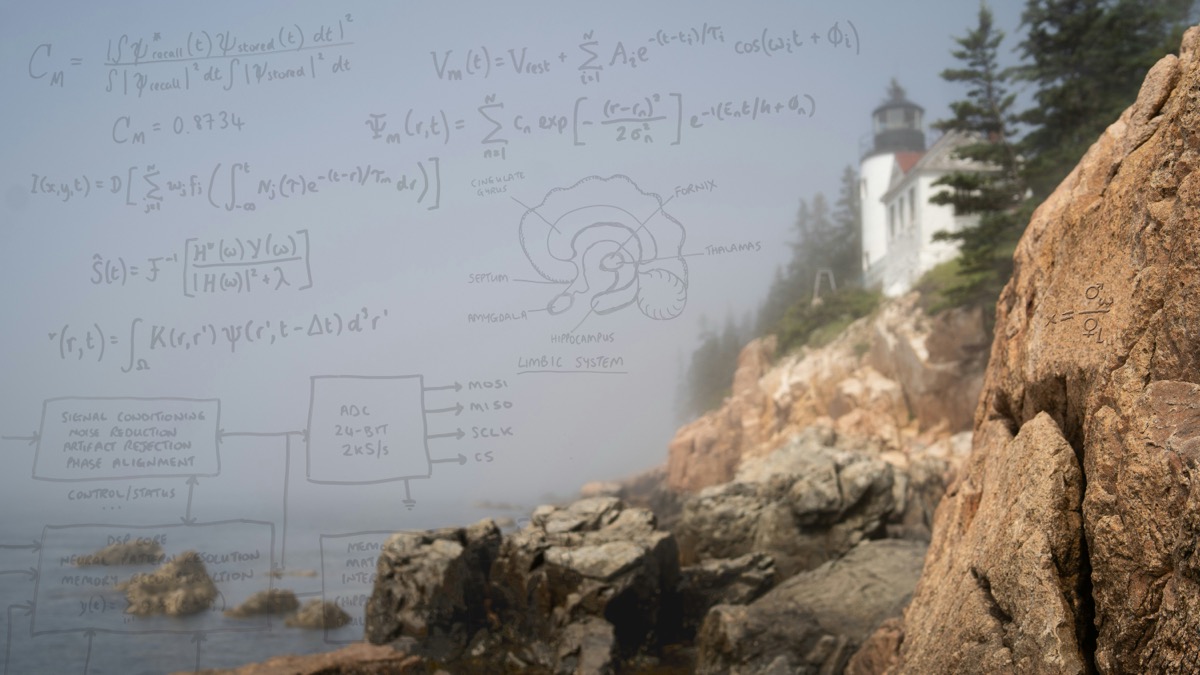
Carola Cox remix of own drawings and photo by Derek Laliberte
Solve for X
by Kristen Koopman
Julia’s hands only tremble a little as she untangles the wire leads of the illicit memory-sharing device. That’s to be expected, she rationalizes to herself, when connecting one’s brain directly to an untested experimental technology in a dim, cramped living room of a one-bedroom apartment rather than, say, an actual fucking lab. Admittedly, an activity like this should also have the approval of the university’s bioethics committee and probably a dedicated emergency medical staff, but Julia isn’t going to think about that.
She grounds herself instead by steadying the sides of her hands against the dinged surface of the coffee table, feeling the pre-stiffness settling into her legs from being curled beneath her and crushed against carpet, which wouldn’t be an issue if—
Julia doesn’t think about the couch. She doesn’t think about its occupant because she can’t, not if she actually wants to do this. She needs to be Dr. Julia Castillo, a creature of equations and models and, when she needs it, spite. This is nothing more than another problem, and she knows how to solve problems.
There are the givens:
- Newly-minted faculty member Dr. Julia Castillo, Julia to her friends and Doctor Castillo, actually, to every white guy who just assumes her first name is fine;
- D. candidate Mercedes Guerrero, seven years into a degree that everyone agrees should’ve taken four, notably not writing the abject apology letter she said she would; and
- Mercedes’s brilliant, paradigm-shifting memory-sharing device.
There are the constraints:
- Mercedes’s poor choice and active antagonism of her future career path;
- Whatever the rules of the aforementioned unprecedented technology turn out to be; and
- The general guidelines of professional conduct, probably.
And there is a goal: save Mercedes from herself.
Whether she likes it or not.
Givens, constraints, goals. Solve for x.
The bubble of Julia’s illumination trembles around her. She hadn’t bothered to turn the lights on when she’d seen Mercedes, relying on the flashlight in her phone, and now the outside world exists only as the intermittent flick of the lighthouse, just close enough to make the rent affordable to an overdue grad student. The evening fog curling in from the still-open door flashes, soaking the air with the lighthouse’s steadiness and marking each moment Julia fails to act.
“I can’t believe you,” Julia hisses at the unconscious Mercedes. Not that Mercedes can hear—as far as Julia knows, there isn’t even a way to force Mercedes out of the memories she’s tapping into.
Except to go in after her.
“It works,” mutters the sullen memory of Mercedes in the remembered version of Julia’s office ten days ago, uneditable and pristine. Mercedes sits sideways in an armchair on the other side of Julia’s desk as Julia—or Julia’s consciousness, or whatever part of Julia’s awareness is actually participating in this recreation of a memory—watches her own past-self plug in the electric kettle. The memory fills her senses now: the building heat of the kettle, the cottony sleepiness on her tongue, the resigned exasperation of this again? and couldn’t she have waited until after my coffee?
And Julia’s past is here, too, observed by her present. Her present, which stands next to her own desk and the memory of herself as if she has a body. It’s astonishing work: Mercedes managed to take a former grad student’s virtual reality code and hardware and a way to sync it across multiple people, while somehow maintaining enough separation to work through memories therapeutically and not just relive them.
“It could work,” past-Julia agrees, measuring instant coffee into two mugs. Despite Julia’s separate embodiment, the sensations and emotions of the memory tug at her. Her past-self’s tone stays even and patient—a qualification, even in present-Julia’s opinion, for sainthood. Our Lady of Diversity Hires, Nuestra Señora del Tokenismo, guardian to new postdocs and grad students everywhere. Although surely Julia getting an actual professor position, not just a lecturer or yet another postdoc, counts as a miracle, and not being the only woman in the department is just the cherry on top, even if Dr. Hart is a bit—
A sharp, dizzying pull shoves Julia into another memory:
Dr. Hart looked at Julia over the rims of her glasses, the reflection of the red pen on the paper before her as bright as blood drops on the lenses. “We were all disappointed that Mercedes didn’t pass her proposal defense on the first try, Julia, but solving other people’s problems doesn’t teach them how to solve problems.”
Julia thought, neither does doing nothing and watching them suffer—
The rabbit hole of memory-within-memory ends as abruptly as it started, leaving Julia reeling. She puts a hand against the memory of her desk, even though she has no true physical form here and the only nausea she experiences is existential.
The Julia of a week and a half ago, oblivious, continues, “But your proposal defense is supposed to be an exchange of ideas, marking your entry into the community of academia. You’re not supposed to bring a completed prototype for your thesis project, so you’ll have to forgive us for being a bit surprised!”
Mercedes, in one of the many informal brainstorming sessions that Julia considered vital to morale and the free exchange of ideas—and that Dr. Hart found to be an inefficient use of both of their time when Julia let them slip—had brought up the possibility of nested chains of associations as a potential issue. That didn’t make Julia any more prepared for the reality of the experience—the sheer viscerality of reliving a memory while reliving another memory. And she hasn’t even ventured outside of her own memories yet; the whole point of the machine, and her sojourn into it, is to share memories, after all.
There are no analog controls, no pilot’s yoke or joystick to direct her travel. From what Mercedes has said, Julia should be able to see Mercedes’s consciousness the same way she’s experiencing her own, and going from memory to memory is…possible, at least theoretically.
Luckily for Julia, this is a shared memory: an easy bridge. Julia focuses on the past Mercedes sitting across the desk, and the version of reality around her slides sideways, the details morphing with a fluidity that builds a skull-fracture-sick heat in Julia’s head.
Mercedes’s senses dwarf Julia’s own, her skin barely containing the jitters of her misery. The midmorning sunlight has tilted to a shallower angle in Mercedes’s recollection, and the heat of the kettle dissipates out of Julia’s perception. The details of Julia’s office, the patterns of wood grain and constellations of decades-old stains, fade into Mercedes’s inattention.
The exception is Julia’s degrees, framed and hung on her wall. Mercedes remembers those, for some reason, in perfect, crisp detail, and it pangs something in Julia’s chest.
“There’s no rule against it,” Mercedes reminds her, half-prickly and half-sullen, as she knocks her heels together off the arm of the chair; the impact reverberates in Julia’s ankles. “And you’re the interim grad program director—if you have a problem with it, rewrite the rules. Or, for that matter, just refuse to sign off on the exam results.”
Julia…could do that. In theory. The same way that she could, in theory, have declined to serve as the interim chair and cited the exhaustive workload of a pre-tenure faculty member; the same way she did, in practice, selectively hear around Dr. Hart’s insinuations that she shouldn’t be on Mercedes’s committee. But there are so many hills; Julia can’t die on all of them.
“There are no exam results,” past-Julia reminds Mercedes. “Not until I file the paperwork, and I’m not doing that until you’ve exhausted all your options. Which is why you need to apologize. Then we can do an actual, real defense, and I’ll file the results from that one.”
Mercedes scoffs. “As if it’ll be any different. The rest of them don’t care about my work. Especially Davis.”
Past-Julia hisses an inhale.
Another whiplash-pull into a fragment of memory:
In Julia’s office, the door was open and voices filtered in from the hallway. A distant knock and Dr. Davis’s voice: “No, thank you, my trash is fine.”
Silence, then Mercedes’s: “Dr. Davis, I have an appointment with you now…?”
“Ah,” Dr. Davis said after a moment that slithered down Julia’s spine to the pit of her stomach. “Mercedes, is it? Come on in, then.”
“I just—I have to ask,” Mercedes said, and Julia thought no you don’t, you know better than to try this—“Do you mistake all the students for janitors?”
Julia held her breath so hard she thought her lungs might pop.
“What’s that supposed to mean?” Davis asked. The edge to his voice was sharp enough to make it obvious that he knew exactly what it meant.
Eyes closed, Julia thought, drop it, drop it, drop it.
Finally, Mercedes said, “Nothing. I guess.”
Julia breathed a silent sigh of relief and—
—wrenches herself back into the right memory as her past-self tells Mercedes, “Obviously Davis is an ass, but if you go around talking about it, you know you’ll be the one they call a troublemaker.”
Mercedes says over her, “Yeah, I know, okay? I haven’t said anything.”
It’s a little worrying, Julia will admit to herself, that she got pulled from Mercedes’s memory into an intrusive memory of her own. She had hoped, if she’s being honest with herself, that hiding out in Mercedes’s memories would shield her from the vicissitudes of remembering, but no. It seems that, like every time Julia has caused trouble just by being present, she’s brought her problems with her.
Past-Mercedes’s exhaustion pulses through Julia now, a yawning knot of despair at the base of her throat. But Mercedes shows no outward signs of it as past-Julia pours solidarity liquor into the mugs of instant coffee.
“Don’t let it get to you,” past-Julia says. “Just ignore it.”
It’s good advice, and Julia takes it from herself, letting her concern about treacherous hidden memory-traps drift away with well-practiced effort.
Mercedes, on the other hand, doesn’t take the advice. She sighs, and her tension rises in Julia’s shoulders. Reality gives another nauseating heave, and:
Julia’s teeth clenched so hard her jaw nearly cramped, eight years ago in Intro to Statics, and Ian, goddamn Ian, talked over her yet again to tell her why her answer was wrong, even though it wasn’t, but nobody in the study group ever backed her up when she called him on it—
Present Julia is, if not prepared, at least alert, and she focuses on Mercedes’s senses: the solidity of the chair as Mercedes’s heels bounce absently off the armrest. The warm ceramic stick of the mug against the insides of Mercedes’s fingers.
Mercedes who, ten days ago, makes a noncommittal noise, bringing the mug close enough that Julia tastes the mellow-sharp scent of bad coffee and cheap alcohol.
If present-Mercedes is here the way that Julia is, she reminds herself, then Julia just has to find her. And if she’s working backwards…
Julia focuses on the future, and the last thing she feels is the bitter blaze of spiked coffee on her tongue.
The lighthouse is dark in Mercedes’s memory, blackening clouds and the itchy-sweet scent of wildflowers. Past-Mercedes, sitting at the picnic table at the cleave of rocky shore and meadowed land, furiously avoids past-Julia’s eyes.
The memory of only a few days ago, now. After the proposal defense.
Julia feels the whole-body tremble of Mercedes’s overdose of feeling as Mercedes says, “Gosh, if this is what an intervention looks like, TV really got it wrong. Unless you’re doing this for all your students—sorry, all your friends?”
Julia has no other students, and Mercedes knows this. Julia has yet to achieve the security of tenure: the vaunted milestone that announces to the world (well, the academy) that someone has finally made it. Tenure, Dr. Hart told Julia, is when everything changes; when everything becomes worth it. It’s when a professor can take on risky students like Julia. Julia had listened obediently to Dr. Hart and had told Mercedes to bring her the paperwork anyway.
“Nobody else needs one,” past-Julia snaps back at past-Mercedes, and Julia remembers saying this, remembers meaning that the other students didn’t need Julia, not the way Julia had needed a Julia when she was a Mercedes—
From the doorway, Julia could see that she was a dark spot in a sea of pale masculinity. She’d never known a room of people could be this…uniform. She almost walked out again but no, she said she was going to get this degree and she damn well would if it meant that one day someone else would walk into a room like this and see her and not feel so alone—
Present-Julia hauls on the wash of Mercedes’s electric panic to tether her back to the lighthouse. Here, past-Mercedes grinds out, “I brought them a finalized design. That’s what we’re supposed to do, right? Why is that—”
“It’s not how you play the game,” past-Julia interrupts. Present-Julia finds herself observing with the same detached assessment that she brings to grading problem sets. Mercedes is too emotional, too defensive, reactive and reactionary towards things she can’t change: partial credit at best, a scrawled see me in red ink at worst. Past-Julia helpfully provides the critique, articulating the boundary conditions and relevant equations: “When you’re a student, especially with this committee, you need to show them you respect them.”
Mercedes snorts. “This committee? Like there was anyone else I could’ve asked?”
Subtract two points for the sunk-cost fallacy; but Julia knows what Mercedes means. Mercedes’s work is based on modifying a design that belongs to the lab, using materials that belong to the lab, and working on software that was developed in the lab. Finding other faculty, going to a different lab, would mean starting over and abandoning the project that Mercedes already poured so much of her time and energy into—even setting aside the fact that Mercedes actually gives a shit about this project, which even Julia has to admit is relatively unprecedented in this field. Will, the grad student who had spent five years of sixteen-hour days developing the VR system the Nemotecnia is based on, had moved on to a six-figure-paycheck bumped up to seven figures with bonuses at a consulting firm and had left his advisor, Dr. Davis, in charge of the patents.
Not that giving a shit is doing Mercedes any favors. The ashy cast of her skin points to sleep deprivation as a lifestyle choice, and Julia can feel how the exhaustion weights her bones against the twitchy energy of too little sleep.
Past-Julia continues, “Respecting them means asking them for help, showing them they’re important, not one-upping them!”
Mercedes crosses her arms and gives Julia a flatly skeptical look. “I thought my work was supposed to speak for itself?”
“Your work is about truth,” past-Julia tells her. “Function. It works, or it doesn’t. But getting the degree isn’t about truth—it’s about convincing a group of people who think they’re always right that you can be right, too. Let things blow over. Lay low for a while, for Christ’s sake.”
Mercedes purses out her lips. “Interesting advice for a field where we’re basically supposed to live in the lab.”
Past-Julia takes a deep breath, and present-Julia can’t help but wince in anticipation. This is where it’s past-Julia who gets partial credit for applying tough love when maybe any other approach would’ve been better. “Your keycard access to the lab has been revoked.”
Mercedes jolts up, her hands flattening against the table and pressing flakes of old paint against her palms. “It what?”
“You misappropriated lab materials to make an unauthorized prototype,” past-Julia says. Her voice is firm and unflinching, its ease directly proportionate to Julia’s profound discomfort with the decision. Will would’ve gotten away with it. Will would’ve been praised for his dedication and passion.
Past-Mercedes’s eyes narrow. “Are they doing that now? Right now? So, when you said you wanted to get away to nature, you were just luring me away—”
Present-Julia stops listening, because beyond the memory of Mercedes stands—
Another Mercedes, staring back at her, eyes wide. “How did you—”
“Mercedes?” present-Julia says, momentarily struck dumb by her own success.
But the other Mercedes—present-Mercedes?—has fury in her eyes. “So, it wasn’t good enough for a proposal defense, but it was good enough for you to hook yourself up to?”
“Mercedes, wait—”
“No,” Mercedes snaps, “and also, go to hell.”
And she disappears.
Julia runs to the space she occupied. Where she stood, there’s a wake, an impression curling like smoke: panic and sharp fuck-you refusal.
But Mercedes can be reasoned with. Julia knows she can be reasoned with.
And now she has a trail.
The wake takes her to a year ago—their first time at the lighthouse park, an actual getaway to nature, toeing their way across slabs of rock gone slick-black with low tide. It’s a five-minute walk from Mercedes’s apartment, but the roaring hiss of surf feels like an entirely different world to the lab, a downright indulgence.
“It’s a little morbid, you know?” past-Mercedes says, one hand shading her eyes as she continues a thought present-Julia missed. “Like, how many shipwrecks do you think it took before they put in a lighthouse?”
“Probably a lot,” past-Julia says, hopping gently across a crevasse gouged into the rock. “Are you trying to avoid the question?”
Mercedes’s attention snaps back to her. “Sorry, what? I got distracted.”
Past-Julia repeats patiently, “So the department’s only ever been white guys?”
“And Dr. Hart,” past-Mercedes confirms. Present-Julia pointedly ignores the guilty twinge the memory brings her—there are no bags under this Mercedes’s eyes, no despondent slumped shoulders. This is the Mercedes Julia is here to rescue, the one who’s buried somewhere under her misery and poor life choices. So, Julia takes the moment to linger, to remind herself what’s at stake: the correct Mercedes. The ache in her chest at the memory of joy doesn’t play into her decision-making. “We had Dr. Zheng for a while, right when I first started, but he left. Got an offer in California, and—well, he said it like a joke, but they knew how to pronounce his name there.”
Past-Julia sighs. “Ooph.”
Ooph still feels like an understatement. This job had been everything Julia had ever dreamed: a prestigious East Coast university with the traditional climbing ivy and stoic architecture, a department with big names and bigger grant dollars, a cozy college town located right on the sea, complete with historic lighthouse. The fact that it was easier to find farm-to-table elevated American brewpubs where you could pet the cows that would become next month’s steak entrée than it was to find plantains, let alone another Latina, was a bit of an adjustment.
“And you, now,” past-Mercedes reminds her with a grin. “Doctor Castillo.”
Present-Julia winces at the same moment as past-Julia. “Ugh, don’t call me that.”
“You earned it,” past-Mercedes insists. “You’re living the dream!”
“I did earn it,” past-Julia agrees. “Which is why I get to decide who calls me that. Dr. Davis has his students call him by his first name.”
“Students?” Past-Mercedes rolls her eyes. “I think you mean ‘his pack of adoring dudebro proteges.'”
“Exactly,” past-Julia tells her. “So, you call me Julia. They call me Dr. Castillo. I may not be a tenured, endowed, full grand-poohbah or whatever, but I can at least decide who gets my help. And let’s be honest, it’s not like Dr. Davis can give you advice for most of the shit you’ll be dealing with.”
“Davis is most of the shit I’m dealing with,” past-Mercedes mutters.
Present-Julia watches with her heart in a vise. The correct Mercedes, she now remembers, could jest about it. The correct Mercedes reminded Julia of herself.
The correct Mercedes looks down at her arms. “God, I always forget how pasty I get in the lab. And, man, they call this a summer up here?”
Past-Julia cracks a grin. “That’s one way to deal with Dr. Davis. ‘Two shades lighter and she suddenly seems more rational!'”
“‘I really see myself in her—let me give her funding!'” Mercedes agrees, laughing.
Julia can’t take any more of this. This—this is a reminder that she’s here to help, here to make sure Mercedes gets through this and makes it back to this version of herself. She closes her eyes, finds the faint undertow of present-Mercedes’s trail, and skips ahead.
Chilled spring air—a month ago, Julia guesses—draws up fingers of fog from the campus pond. Dull morning sunlight strains through an overcast sky, and past-Mercedes sits in a plastic chair by the shore with a stack of articles in her lap. Wind-ripples on the ignorant water pass through present-Julia’s ankles where she stands in the shallows.
Steady as the lighthouse, the silhouette of Dr. Hart walks down the path by the pond—the quickest route, Julia knows, from the good faculty parking to the engineering building.
“Hard at work?” Dr. Hart says lightly, suddenly next to past-Mercedes. “Good. What’s the saying? Everything a man can do, you’ll have to do backwards and in heels. Speaking of, I heard you had some friction with Adam—Dr. Davis.”
Mercedes’s breath stops, every muscle seizing up. Even Julia freezes—this is before the proposal defense, so there’s only one incident Dr. Hart can be referencing. Past-Mercedes bubbles with mixed panic and hope, that maybe someone will acknowledge what happened—
“The field is full of Dr. Davises. If you can’t handle it…” Dr. Hart shrugs. “Better to know early, I guess.”
A sinkhole opens beneath Julia’s ribs. “What?” she demands, even though she knows the memory can’t respond. She knew Dr. Hart could be a hardass—hell, it had even been something she’d admired—but she still would’ve expected more of her than if you can’t take it, you might as well quit now—
“…yeah,” Mercedes says, her voice small.
“Proposal defense next month, right?” Dr. Hart says, oblivious. “Just send me an update beforehand.”
Dr. Hart starts to walk away and now, beyond her down the shore, stands another blurred figure.
“Mercedes!” Julia calls again, even though she knows it’s futile.
Mercedes bolts, but Julia finds it again, that barely-there sense of Mercedes’s passage, and follows her with gritted teeth.
A large lecture hall with bland whitewashed walls, no natural light, and the indescribable odor of decades of campus carpet stains. Past-Julia, ten years younger, sits in the front row, desperately scribbling Greek letters in a notebook as a professor draws angles on force diagrams. A transparency projector throws the shadow of a pen tracing green light onto a screen behind him.
The professor says, “It’s all about the angles. Remember that when you’ve got wives, boys.”
The room erupts in snickers, and past-Julia’s pencil hesitates. Present-Julia feels her crawling realization—that the professor looked at the class and saw a world with no place for her and saw it so strongly that he didn’t even see her existence.
And across the room, Julia sees present-Mercedes, her jaw set and her hands fisted. As soon as their eyes meet, Mercedes brandishes both her hands with her middle fingers extended before disappearing again, leaving a faint path through the dense fog of stubborn fury that’s trying so hard to turn the memory into a bear trap of emotion.
That, Julia realizes, is exactly what Mercedes is trying to do.
Julia should back out. She should go back to the memory of hooking herself up and ride it to her own awakening and wait Mercedes out rather than chasing her through a worst-of compilation of Julia’s experiences in higher education.
But Mercedes is here, and despite everything, Julia can’t bring herself to give up on her.
So, she grits her teeth and moves on.
Julia’s first postdoc, now, back at her old university. Past-Julia is laying a folder at each seat of a conference table, familiar enough to her that the details fade away. Present-Julia closes her eyes for a moment to steel herself as she immediately recognizes the memory: the meeting she convened to discuss her first grant proposal as a project leader. Cool air wraps around Julia’s ankles and her toes ache with the pressure of wearing heels, dulled by familiarity—though she had switched to flats after this.
A head pokes in—Julia can’t even remember his name anymore, and, frankly, good riddance. Some prestigious named chair of something-or-other. “If you wouldn’t mind getting some coffee, my dear, I’m sure Dr. Castillo will appreciate it when he gets here.”
Julia’s breath catches at the spark of fury beneath her sternum.
A moment. Then: “I’m Dr. Castillo.”
Dr. Prestigious stares right back. “Huh. Guess the department got a twofer with you, didn’t we?”
The spark catches and turns into a towering blaze—
Leaning over a lab table in her first college physics lab, she watched a marble roll down an inclined plane. Its clear glass focused a mote of brightness onto the table as it rolled, and she thought, this is what physics is: that spot of light, the clean smooth roll of the marble, refraction and angles and counting seconds to work backwards to gravity. These glimpses of the clockwork tick of the universe, and when she looked up, her lab partner wasn’t looking at the timer. He was staring down her shirt, and her triumph turned to sour humiliation.
Julia staggers, grasping at the table to steady herself.
In the memory, as Dr. Prestigious turns away, another professor—even less memorable—takes his place, chuckling ruefully.
“That’s Dave for you,” he says, shaking his head. “I mean, it’s not like he could’ve confused you for all the other women in the department.”
Ah, yes. The “punchline”: Julia is alone here, trying desperately to make the best of it.
Past-Julia’s stillness deepens, and she bares her teeth in a grimace that can’t possibly be mistaken for a smile. Present-Julia remembers thinking: I am going to outlast you, motherfucker. What past-Julia says is: “No. He certainly couldn’t.”
Mercedes made a mistake bringing Julia here—this is only strengthening her resolve. Julia didn’t put up with things like this just to watch a mind as brilliant as Mercedes’s leak out of the academy because of these assholes. Julia always knew she would have to outlast her antagonists, even—especially—the ones who thought they were helping her. If she has to outlast Mercedes too, then fine.
She detaches herself from her stale humiliation, walking through the conference room until she finds the wisp again and reality blurs into—
The door clicks shut next to a full-wall whiteboard, covered in math, circuit diagrams, and what seems to be an abstract expressionist rendering of the limbic system of the brain. Julia knows this conference room; she knows that whiteboard, she knows what’s on it.
Sure enough, Drs. Hart, Johnson, and Davis sit around the table—with past-Julia. The spot at the head is open, having been recently vacated by Mercedes. It is two weeks ago, and this is Mercedes’s proposal defense. Specifically, the part where Mercedes has to wait outside while her committee confers and decides not to pass her.
Her prototype sits in the middle of the table.
Past-Julia’s disgust and grief ripples through present-Julia as Davis speaks. “Part of getting the degree is learning to take criticism. She’s gotta be able to hack it.”
“This meeting,” Dr. Hart says, even though her expression is closer to resigned agreement, “is about her work, not her attitude. So, let’s talk about it.”
God, Mercedes brought her here? Here? What does Mercedes hope to get out of this? Did she get a thrill out of feeling Julia’s emotional rollercoaster of hoping Mercedes’s work will get a fair shake only to be shot down?
Johnson leans forward. “Look, we have a duty to look out for her best interests, right? With this kind of theory, maybe she’d be more comfortable in—biology, maybe. Or neuroscience.”
Present-Julia feels the muscle twitch in past-Julia’s eye. But past-Julia is staring intently at Dr. Hart now, waiting for an intervention that isn’t going to come.
“We can’t coddle her,” Davis agrees, absently grazing his eyes over the diagrams on the whiteboard.
By the door, Julia feels Mercedes again: an unsettled, sick indignation, and below it, the bitter regret of entirely predictable consequences coming to pass. It’s strong, but not strong enough to catch Julia unawares—she made a career, an entire life out of dismissing it—but present-Mercedes can’t be far ahead, so Julia jumps to—
Only a few minutes before the door closed, but Mercedes’s version. The prototype on the table shows the impeccable detail of its creator’s attention, every grain of texture on its chassis clear and crisp. And through Mercedes, Julia feels…
For once, Julia feels light. Hopeful. Optimistic, even. The pulse-quickening sense of accomplishment that comes after oceans of red-inked problem sets, sitting through corrections of work done right the first time, unanswered emails and faint praised buried beneath a mountain of pointed-out flaws: of having something, finally, complete.
And Julia has to admit that it worked. Even past-Julia, oblivious to the absolute shitshow about to hit the room, looks on the prototype with pride. There can be no nitpicking or qualifying Mercedes’s achievement. That present-Julia is here at all shows: it worked.
“Therapeutic uses, I think,” Mercedes says, continuing some conversation that Julia missed this time around. “Or conflict resolution. To allow people to access each other’s memories, to understand their experiences—it might even be worth trying out amongst ourselves.”
“That’s not necessary,” Davis breaks in, barely focusing on the prototype in front of him.
“You should try it,” Mercedes insists, her hope hardening to determination. “The original idea was to share memories.”
“If it even works,” Davis murmurs, tapping the end of his pen against his notebook. He doesn’t even look at Mercedes.
The tension thrumming through her like a bowstring snaps.
Past-Mercedes says, bland to the point of frigidity, “You’ve done so much in your tenure here, Dr. Davis. Don’t you want to see what that looks like on the other side?”
Present-Julia closes her eyes in disappointment. She remembers—not with the full-body jolt of being pulled into the memory, but with the comfortable distance of recalling a memory that’s been pulled to shreds and overanalyzed in the hopes of finding a way it could’ve gone differently—that this was when she knew it had gone wrong. The feeling had crawled up her body as if she were slowly lowering herself into icy water.
Davis nudges his notebook towards Dr. Hart and underlines something in it.
Dr. Hart reads it and takes a moment to process. Then she says, “You’ve given us a lot to think about, Mercedes. Could you step out so we can discuss it?”
Past-Mercedes looks at her for a long moment, then glances at past-Julia, who meets her gaze with anguish in her eyes before looking away.
Mercedes’s silence coats the room like poisoned honey. Then she stands.
She’s nearly made it to the door before Johnson says in a too-loud, too-jovial voice, “At least no one’s going to tell you to take out the trash this time!”
Present-Julia gasps this time, taking it like a blow. In the moment, she had frozen, and she hadn’t even fully understood it until days later, when, in the middle of the night, as she lay unable to sleep, the thought pierced her: how did Johnson know?
Now, Julia knows that Dr. Hart knew, too. That Davis had apparently felt completely fine relating the humorous anecdote to his colleagues, so much so that Johnson felt perfectly comfortable turning it into a goddamn joke.
The memory reels Julia out into the hallway. Despite her incorporeality, Julia’s hands shake. It’s probably something akin to psychosomatic, and there will probably be plenty of grant money available one day for studying why the brain insists on doing it in this unreal memoryspace. Not that it seems likely Mercedes will get any of it.
Mercedes, who etched her soul in circuits and equations on that board, hoping that maybe they would finally see her work, and it still ended up being a setup to a punchline: that she could ever have been good enough.
And there, leaning against the wall on the other side of the hallway, stands present-Mercedes. There’s no fight in her; her gaze is empty, not even tracking the past-Mercedes pacing between them.
Present-Mercedes says, “Do you know why I made the Nemotecnia in the first place?”
Julia is exhausted, and her exhaustion drives her to honesty: “Because you’re brilliant.”
“I thought,” Mercedes continues, ignoring her, “that if people could share memories, we could understand each other. Maybe they could see what I see, feel what I feel, and finally change.”
It takes a moment to filter through to Julia, but once it does, she forgets for a second how to breathe—not with possibility, but with terror. What if they experienced it all and still didn’t understand? What if the whole of Mercedes’s life was judged to be simply the sum of its parts, if they missed the way each incident accumulated into overwhelming weight, the way the possibility of another slight invoked the whole of everything that came before? What if Mercedes was irrational, overemotional, hysterical? What if Julia was?
What if it had been in their heads the whole time?
Mercedes snorts at Julia’s silence. “I know, right. What an idiot.”
Julia brings her hands up to rub at her face. “You’re not an idiot. You’re better than them.”
“I don’t want to be better!” Mercedes snarls, taking a surging step towards Julia. “Better is backwards and in heels, and, you know what—this was better! I just want to be good enough. And when I never am, no matter what I do or how much I produce or how high the bar is supposed to be, what am I supposed to think except that it’s what I am?”
This isn’t working. Julia can tell this isn’t working, and past-Mercedes’s bubbling fury courses through Julia’s veins, her pulse thudding in Julia’s ears, and she needs out. She has no idea if this will work, but she reaches out to grab Mercedes by the arm, and apparently their incorporeality is compatible because she successfully pulls them both into another memory where—
Past-Mercedes, limp and empty, lies on her couch. Present-Mercedes goes still under Julia’s hand.
“This is what you are,” she tells Mercedes. “This is you right now. I know how everything looks, I know you’re angry—”
“Angry?” Mercedes repeats incredulously. Her mouth stays a little agape after she says it, like she’s too distracted searching Julia’s expression for any sign that Julia knows how wrong she is. “I’m not angry. Julia, I’m miserable.”
Julia stares at her for a long moment. That can’t possibly be right. Julia remembers being Mercedes: relishing the three-a.m. buzz of halogen lights and meeting sunrise through the windows, before the degree on her wall and the letters after her name and the publish-or-perish. It got her through years of lecture halls named after dusty pale geniuses, the hesitations of surprise when she introduced herself as Doctor, the accumulation of implied you-don’t-belong-here’s invoked with even the slightest misstep and the constant wondering if they wanted people like me, wouldn’t there be more people like me?
But it was always worth it.
“But,” Julia says, her voice faltering, “you’re amazing. Your work is amazing—”
“And I’m miserable,” Mercedes insists.
“I know this is hard,” Julia says, trying not to get frantic. “This is the hardest part, I swear to you, but I know you can make it through if you—Mercedes, I’ve seen you at the whiteboard, I’ve seen you in the lab, I know you love this!”
Mercedes’s face falls, weighted with exhaustion and burnout. “I do,” she admits. “God, I do. We’re in my fucking memory right now, how amazing is that? But I don’t—” She takes a deep breath, letting her jaw slide to one side as she pulls her thoughts together. “I don’t know if there’s enough love in the world to make all this bullshit worth it. Not when it hates me.”
Julia pulls her head back as if struck. “Nobody hates you!”
Mercedes’s eyes narrow, and now she reaches out, snakebite-sudden, to pull them into
Julia’s office, with voices outside.
“I just—I have to ask,” past-Mercedes says, and the bottom drops out of Julia’s stomach in both the memory and her present. “Do you mistake all the students for janitors?”
Present-Mercedes says, “You think Davis ever got mistaken for a janitor? You think anyone ever made jokes about him like that? That he’s spent even a second of his life having to wonder if someone would’ve said that if he weren’t him? And when I try to call him out on it—”
“What’s that supposed to mean?” Davis is saying.
“—I’m the villain,” present-Mercedes finishes. “A threat. How is that anything other than this job—this field—this institution loving him and hating me? What other explanation is there?”
There’s something in Julia that is trembling like a dam about to burst. But she says, “Look. I’ve been where you are and I understand what you’re going through—”
“I don’t care!” Mercedes explodes. “I don’t care if you understand. Your understanding doesn’t mean shit if it’s still just another way for me to fail to measure up. I am telling you—I have shown you what I’m going through, and you’re still standing here telling me I’m somehow wrong about it? You’re exactly like them.”
Present-Julia opens her mouth to respond, but nothing comes out. She wonders, numbly, if Davis ever walked into a classroom and found himself the odd one out. Dr. Hart had, once; she’d told Julia when she’d started. Mercedes had, too. Multiple times. All the picked battles and brushed-off slights over the years, all the things that Julia stomached to make it better for whoever came next, and now Mercedes is here, coming next, and Julia isn’t even sure anything’s changed.
“Nothing,” past-Mercedes says finally.
“I failed you,” present-Julia says quietly, and it kills something inside her that she thinks maybe should never have been there in the first place. It breaks her first rule of surviving: never admit defeat. There’s no partial credit, no maybe, just correct and incorrect, perfect and lesser, and no in-between.
Mercedes relents a little, her shoulders slumping. “I don’t think it’s failure when there’s no way to win.”
Julia shakes her head. “No. I can’t accept that. There has to be something—what’s the point, otherwise?”
Mercedes looks at her for a long moment, exhaustion and resentment and desperate hope warring in her eyes. “Do you think so?”
“There has to be,” Julia repeats stubbornly. It’s not the sunk-cost-fallacy of her entire career, the effort and the years that she’s put into pursuing this passion that she desperately wants to be worth something. It’s not the naïve need to believe that justice can exist here, in this space that prides itself on fairness and meritocracy. It’s not even the fact that they are standing in the result of Mercedes’s talents, a potentially revolutionary technology that could make people’s lives better.
It’s that there is a girl in front of her who is miserable who deserves better, and her misery is not the result of immutable laws of physics: it’s the result of things that don’t have to be the way they are.
Julia forgot that, too.
She holds a hand out to Mercedes. “Will you come with me?”
Mercedes watches her for a long moment, and then, tentatively, takes Julia’s hand.
It’s quiet in Mercedes’s apartment, interrupted only by the rustling of past-Julia unravelling wires. Julia lets Mercedes’s hand fall away.
“You know,” Mercedes says, subdued but conversational, “I thought if I went back and looked through everything that happened, I’d pinpoint where it went wrong.” She shakes her head slowly, throwing her hands up halfheartedly. “There was no turning point. It just…happens. Every little thing adds up and adds up and adds up until we’re stuck under a mountain and they’re still seeing molehills. They can’t imagine always being told the right answer is a different one, until the only problem that’s left is you.”
“You’re not a problem,” Julia says. “You’re brilliant.”
Mercedes looks down with a scoff. “You keep saying that. It’s not gonna be the thing that gets me to come with you.”
“It’s true,” Julia insists.
“If it’s true, how come you’ve never said it before?” Mercedes asks, her mouth going tight. Beyond her, past-Julia raises her set of electrodes. “I’m not an idiot, Julia, I can read between the lines. Especially when the lines are written in red pen and are all changes you want me to make.”
Julia breathes steadily against the constriction in her chest as she adds another point to her mental list. “Then that’s another way I failed you,” she says. “I guess the good news is, it seems like a relatively easy fix. I’ll say it, because it’s true.”
Mercedes bites her lip, glancing over where past-Julia is affixing the leads to herself.
“Do you really think things will get better?” she asks, her voice small.
“I don’t know.” The admission burns. “But I’m going to try to make it better. Not make you fit into how bad it is—actually try to fix it.” She holds out a hand again. “If you let me try.”
Mercedes examines her expression for a long moment, then lets her gaze fall to Julia’s hand. By her side, the fingers of her right hand twitch, like she’s about to raise it.
Then she disappears.
Julia’s hand stays out, reaching for nothing, and she feels the wake again, the lure of possibility. She can still drag Mercedes back, find her and pull her out by force, prove that she was right all along and make Mercedes understand. The temptation looms, like a familiar memory.
She doesn’t.
Past the space of where Mercedes was, beyond present-Julia’s still-outstretched arm, the memory of Julia closes her eyes.
A tight ache seizes her back from lying on the floor. Her fingers curl against the floor as she comes back to awareness, fingertips dragging along the clammy hardwood. Her vision stays dark as she opens her eyes, and for a moment she nearly panics. Then the glow of the lighthouse flicks through the windows, breaking the dark.
Julia pulls herself up slowly and peels the electrodes off her temples. Mercedes, on the couch, remains unmoving aside from her breathing.
Nothing to do now but wait and see.
Julia staggers to the kitchen, unbalanced by her own physicality. She leans against a counter, winded, then reaches out and knocks over a roll of paper towels just to prove she can.
They fall; this world responds.
She stands there for a moment, watching the paper towels unravel across the tile. Then she moves again, to start making coffee. Hopefully it will sharpen what the Nemotecnia dulled.
A glance at the clock shows that only thirty minutes passed since she went under. If Mercedes doesn’t wake up soon, Julia will have to call someone. Dr. Hart, probably. An ambulance, definitely.
She has a lot of work to do, starting with a form that is going from delayed to denied.
Behind her, she hears a soft shifting, quiet enough that it could just be noise from outside dampened by the walls, her mind becoming accustomed to wakefulness again, or just fervent hope coalescing into imagination.
Julia takes out an extra mug, just in case. Through the window flares the intermittent burn of the lighthouse—a warning, a welcome, a call to come home.
Leave A Comment